
Akihabara · Japan
Anime Production Art Explained Through Genga, Dōga and Cels
Learn what storyboards, genga, dōga and painted cels reveal about an anime scene, with Japanese studio explanations and an artist’s archive experiment.
Genga are drawings of the key moments in an action. Dōga are the cleaned-up drawings and additional poses that carry that action through. A cel is a transparent sheet used for painted artwork in traditional animation. Knowing what each material does helps you see the decisions behind a finished shot. Production I.G’s explanation of genga and dōga, Suginami Animation Museum on cel painting
A drawing on a gallery wall can hold your attention through its line or expression. Beside a related storyboard or finished clip, it can also show you how someone planned a movement, framed a face or carried an expression from one drawing to the next.
The terms you will encounter
| Material | What it contributes | What to look for |
|---|---|---|
| E-konte, 絵コンテ — storyboard | Drawings that communicate the script’s staging and direction to the production team. | The order of shots and the choice of what the viewer sees. |
| Layout, レイアウト | A more specific plan for the composition and staging of a shot. | Where a character stands within the space and how that placement directs attention. |
| Genga, 原画 — key drawings | The important poses and moments that establish an action. | A turn, a stretch, a change in balance or the instant an expression changes. |
| Dōga, 動画 — animation drawings | Cleaned-up key drawings and the drawings that connect them. | How the line and the shape of a character carry through the movement. |
| Cel, セル画 — painted transparent sheet | A colour layer in traditional cel animation that can be placed over a background. | The relationship between the painted area and the space around it. |
The table draws on Toei Animation’s production and training descriptions, Production I.G’s explanation of animation drawings and Suginami Animation Museum’s account of painting transparent film from the back. Toei’s current production outline describes digital colouring and compositing. The terms describe jobs within a process that has changed with its tools. Toei production outline, Toei training courses, Production I.G
Follow one action through the materials
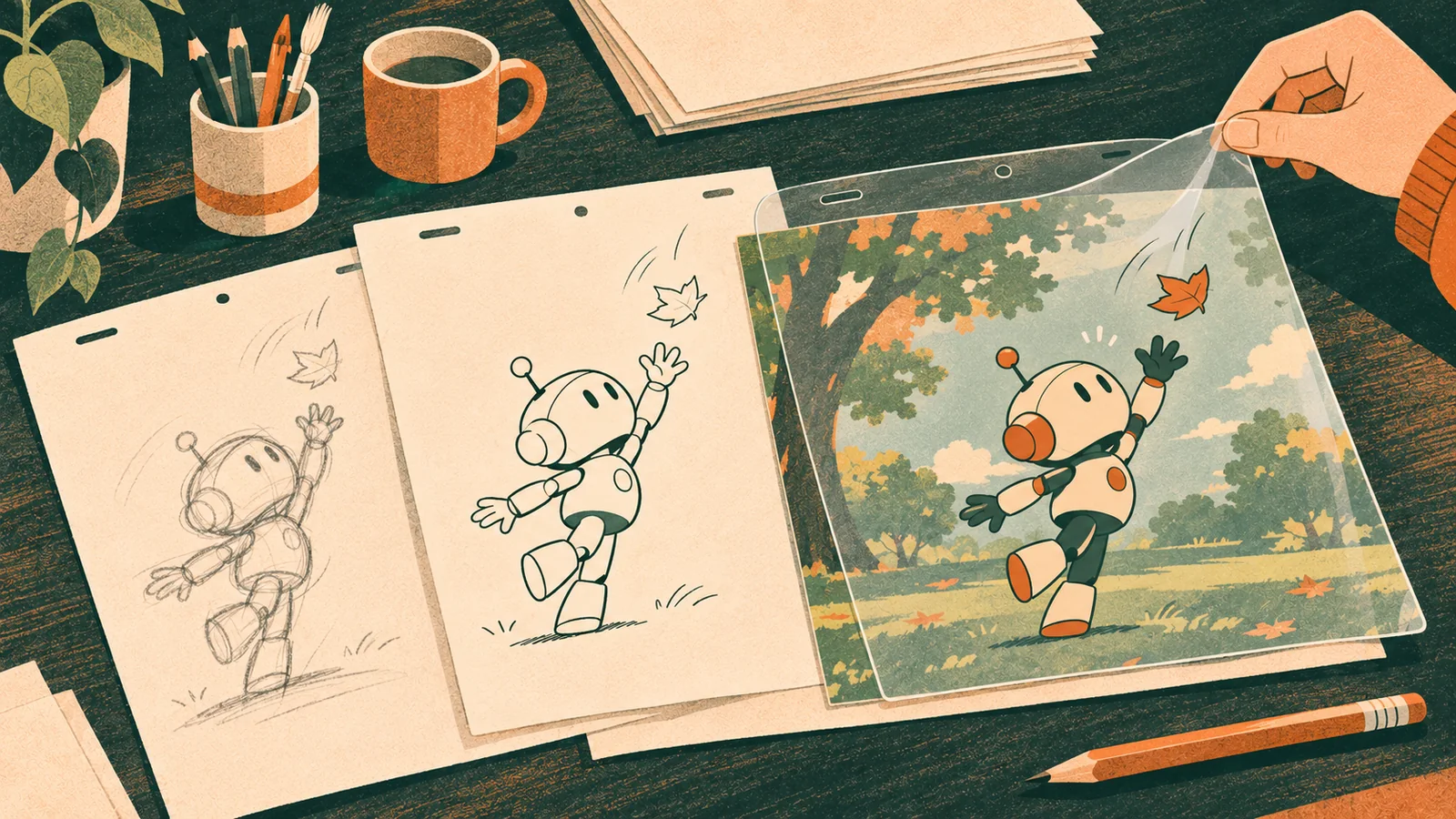
Imagine a small robot noticing a falling leaf, reaching up and catching it. This is a fictional exercise you can use to think about the materials.
In the storyboard, ask when we first see the leaf. Is it visible before the robot notices it? Does the shot include the whole body, or bring us close to the hand? Those choices affect whether the catch feels surprising, inevitable or precarious.
At the layout stage, think about the space the action needs. A hand near the top edge gives the reach a different feeling from one surrounded by open sky. The same character pose can feel different when its position within the shot changes.
With the key drawings, look for the changes that carry the performance. Perhaps the robot leans before lifting its arm, then briefly balances on one foot. Compare its weight and silhouette across the poses. Try to imagine the movement between them.
Production I.G explains that dōga work includes both cleaning up the key drawings and drawing the poses between them. It also stresses understanding the intended movement. When comparing dōga, look at how a curve, hand or face keeps its character as it moves. Studio explanation
A painted cel lets you consider how the character’s colour works against the background. In the fictional scene above, look at the dark hand, the orange leaf and the green trees. Which shapes remain easy to follow? That is a different question from whether the pencil drawing alone is beautiful.
Why one sheet may contain only part of a character
Production I.G’s explanation gives a useful example of how a shot can be divided. Moving and stationary elements, or objects at different depths, may be drawn on separate sheets. A sheet can therefore contain only a mouth or hair, with the other parts supplied by another drawing. Production I.G on separated drawings
If a display identifies the related layers, look for what changes and what stays still. A small moving element can do a great deal of expressive work. Ask how much of a face has to change for you to read a new emotion.
An artist’s way of comparing drawings with the finished scene
For Peel-Apart TV Anime, artist Kazuhiro Goshima worked with materials held by Niigata University’s anime archive team. The university documents surviving scripts, storyboards, key drawings and timing sheets from episode 12 of Dream Warrior Wingman, the television series broadcast in 1984–85. It exhibited those materials alongside Goshima’s installation in 2022 and 2023. University account
In his May 10, 2024 account, Goshima describes projecting the key drawings and finished animation onto two transparent screens with a gap between them. Visitors could move to attend to one image or see both together. Synchronised storyboards appeared on monitors. His arrangement made comparing stages into a physical act of looking. Goshima’s firsthand account
He also describes a limitation he encountered. For ordinary shots, the surviving key drawings marked important points in the movement, while the connecting animation drawings or cels were missing. A preserved group of materials can offer a detailed view of production while still leaving intervals that the finished animation helps you understand.
Miki Ishida, a co-leader of the university’s archive team, described another comparison in a February 2023 discussion. The exhibition placed reproductions of key drawings and corrected key drawings on the wall so viewers could see what the animation director had changed. That makes a correction a particularly interesting object to study. What happens to the acting when the angle of a face, an eye or a shoulder changes? Ishida’s account of the exhibition
Keep looking beyond the finished character
Niigata University uses anime intermediate materials for the broad body of work created during production. Its archive introduction includes scripts, designs, layouts, drawings, backgrounds, recording scripts and handwritten notes. Those different kinds of evidence let researchers ask how a production was organised as well as how a scene looked. University archive introduction
For your next exhibition visit, choose one small action and look for the materials linked to it. Compare what each contributes. The Shojo Manga Infinity guide offers another way to approach original drawings, through page composition and the reader’s attention.
Sources
Researched November 19, 2026. The accounts of the Niigata exhibitions concern 2022–23.
- Toei Animation’s production outline and training courses for the production stages and drawing roles.
- Production I.G’s April 6, 2018 explanation for genga, dōga, cleaned-up linework and separate drawing layers.
- Suginami Animation Museum’s September 2026 workshop notice for painting transparent film from the back.
- Niigata University’s exhibit account, Goshima’s account and Ishida’s discussion for the archive comparisons. Japanese remarks are paraphrased in English.