
Akihabara · Japan
Code Geass Exhibition in Osaka: What to Know Before Visiting
Plan a visit to the Code Geass 20th anniversary exhibition in Osaka: story spoilers, Japanese visitor perspectives and November–December 2026 admission rules.
The Code Geass 20th anniversary exhibition runs in Osaka from November 6 to December 7, 2026, at Space Gratus, on the third floor of the Animate Osaka Nipponbashi annex. It follows the stories of Lelouch of the Rebellion and Rozé of the Recapture, with newly recorded narration by Lelouch’s voice actor, Jun Fukuyama. Official overview, exhibition highlights
For a returning fan, the attraction is partly recognition: encountering a character, scene or line again in a room devoted to it. There is also another way to look, through the choices that turn drawings into a story. Japanese accounts of the earlier Tokyo edition suggest that these interests can coexist, even when a visitor knows one part of the series better than another.
Quick answers for the Osaka edition
Where exactly is it? Space Gratus, Animate Osaka Nipponbashi annex 3F, 4-15-17 Nipponbashi, Naniwa-ku, Osaka. Follow the venue’s own page for the annex location and directions.
What are the hours? Weekdays 11:00–20:00, weekends and public holidays 10:00–20:00, with last admission 30 minutes before closing. November 21 starts at 11:00. December 7 closes at 17:00, with last admission at 16:30. All times are JST. Organizer’s Osaka details
How much is entry? The advertised prices are ¥2,200 in advance or ¥2,500 on the day, including tax. The opening three days use specified date-and-time tickets; November 9–December 7 uses a different period-valid ticket. Neither a published price nor a sales link guarantees remaining admission. Ticket conditions
Should I finish watching first? If avoiding story revelations matters, treat this as a spoiler-sensitive exhibition. The organizer describes a route through the stories, and the Tokyo visitor account discussed below explicitly warns about material touching the ending. This guide avoids retelling those revelations, but cannot promise an exhibition visit will preserve them.
Is English support confirmed? We have not verified English translations of the displays or narration. The Japanese-language programme announcement does not establish an English audio option. Consider how comfortable you are following visual material and familiar scenes without translated explanations.
Recognition, scale and the story between images
The announced programme includes a life-size figure of Lelouch seated on a throne, with photography beside it, and congratulatory messages from people involved in the two works. These offer different encounters: standing alongside a familiar character, then reading how contributors mark the anniversary. Official highlights
A scene watched at home has its own pace. In an exhibition, you choose where to stop, what to look at twice and what to pass. One useful approach is to notice what recognition brings back before reading the explanation. Do you remember a character’s expression, a relationship, or simply how you felt when you first watched?
Then change the question. When production drawings or storyboards are on display, look for how an image guides attention: the distance between people, an empty part of the frame, or the movement implied between two panels. A storyboard sets out shots and action; it is not the same thing as a finished animation frame. You do not need to be an animator to notice a change in framing.
Those are suggested ways of looking, rather than a claim about the exact selection or placement of every object in Osaka. The official highlights describe the touring exhibition; the firsthand accounts below concern Tokyo, whose run has ended.
What two Japanese visitors noticed in Tokyo
Familiarity can make an exhibition personal
池袋の葛西, writing on September 19, 2026, describes a September 13 evening visit as a Lelouch fan. Following the series through the rooms brought memories back, and the seated figure was a particularly strong attraction. The writer had not yet watched Rozé, but still found its storyboards valuable as a way to encounter the work’s production. Original visitor account
That combination is useful when deciding what you want from a visit. Knowing the story can deepen recognition, while a drawing can raise a question even before you know its narrative context. It does not remove the spoiler risk. The account’s roughly one-hour visit, including shopping, is one person’s experience in Tokyo, not a forecast for Osaka’s queues or your viewing time.
A photograph can become a shared moment
In a retrospective published October 15, 2026, Ree describes having rewatched the anime four or five times. At the Tokyo exhibition, another visitor helped take a photograph beside a character panel. The writer also recalls original drawings and video material that could not be photographed. Ree’s account
Here, the souvenir was partly a small interaction with someone else. It suggests a practical distinction: leave time for a permitted photograph, but also for things you will remember without one. Ask before involving another visitor, keep the passage clear and follow the signs at each display. A photograph-friendly feature does not make every room photographable.
These are two enthusiastic, self-selected accounts, not a survey of Japanese fans. Their accounts concern Tokyo; Osaka’s admission conditions below come from the current organizer and seller.
Choose the ticket for the date you mean
The advance-sales deadline is November 5 at 23:59 JST, subject to quantity limits. For November 6–8, choose a specific date and entry interval. For November 9–December 7, the period-valid ticket permits one admission during that period; it cannot be used on the opening three days. Organizer’s ticket page, official Eplus listing
Eplus explicitly starts the opening Friday’s intervals at 11:00; Saturday and Sunday start at 10:00. Follow the actual date and the assembly instructions on your ticket. The interval is an admission arrangement, not a promise of an empty gallery or priority shopping. Seller’s timetable
Collect internet-purchased tickets at FamilyMart; an email or purchase-history screen is not an admission ticket. Seller’s instructions Day tickets are planned at the venue from November 6, depending on remaining capacity on the specified-date days. Remaining places for each interval are unverified.
There is no re-entry. Shopping requires exhibition admission, so make any purchase decision within your visit. Avoid bringing large luggage: the organizer lists no cloakroom or luggage storage. For access needs, accompanying children and the full admission conditions, read the current rules before travelling.
A small plan for the visit
Choose one thing you hope to recognize and one thing you hope to understand. The first might be a character you have followed for years; the second might be how a storyboard makes a pause or a movement readable. Let that pair guide your attention without turning the exhibition into a checklist.
If unfamiliar original manga pages interest you as much as animation, our separate Shojo Manga Infinity guide explores another way of looking at drawn storytelling. It is a different exhibition in Tokyo, with its own dates and admission.
Sources and checked date
Researched October 30, 2026, using the organizer’s overview, highlights and ticket rules, the Animate venue page and Eplus. Recheck current notices before visiting; programmes and admission arrangements can change.
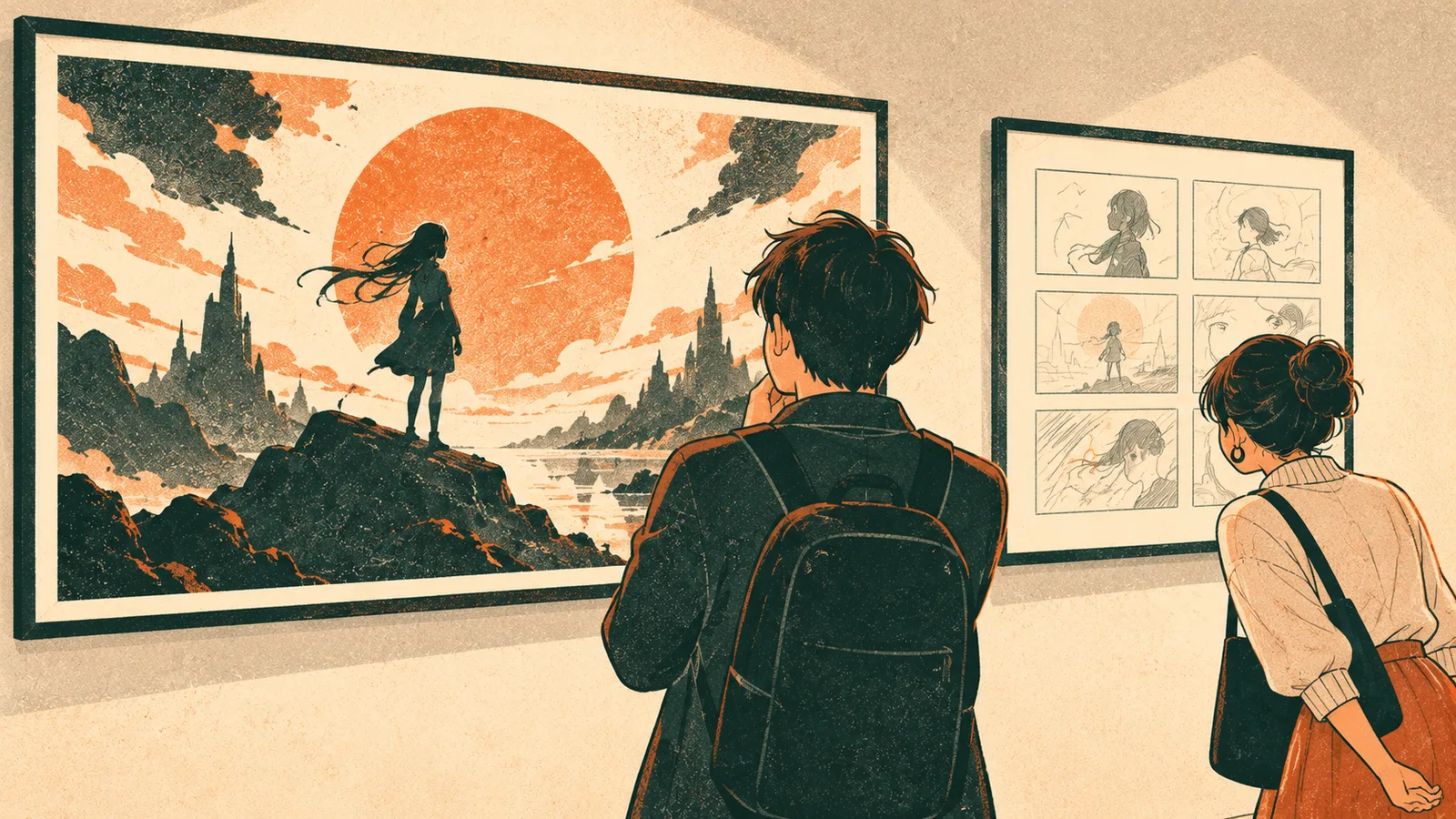
Japanese perspectives are attributed to 池袋の葛西 and Ree. We read and paraphrased their accounts with automated translation assistance. The viewing suggestions are our editorial interpretation; we have not attended this edition or interviewed the writers. The main illustration contains invented artwork and does not document the exhibition.