
Akihabara · Japan
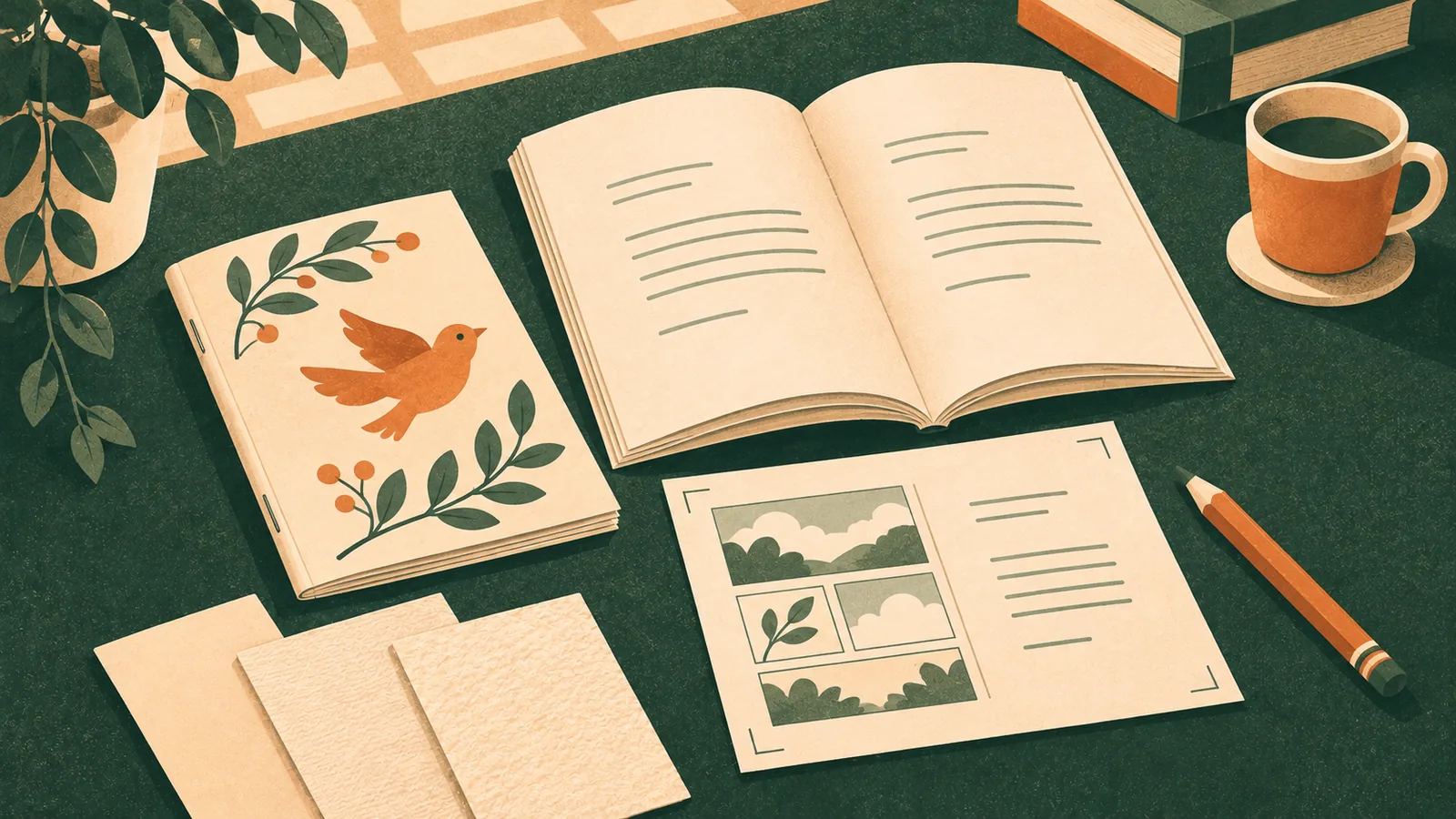
How a Dōjinshi Becomes a Book: Paper, Printing and Personal Choices
How do Japanese creators turn stories into dōjinshi? Two makers explain personal copies, readable pages and paper experiments, with a guide to the printing choices.
A dōjinshi is a self-published work, and making one involves decisions about the physical book as well as its contents. A creator chooses a size, page layout, paper, print method and binding, then prepares files for a printer or makes the copies themselves. The result can be a personal keepsake, something to share with friends, or a book offered to readers at an event.
Two Japanese-language maker accounts show why those choices matter. Em first wanted a copy of an original manga for personal use. chi, a writer of fan-fiction prose, learned from an early book’s readability problems and went on to experiment with paper and ink. Their experiences offer two routes into the same question: what should this story feel like as a book? Em’s interview, chi’s firsthand record
Quick answers
Does dōjinshi mean fan fiction? It can include fan works, but original stories are part of the culture too. COMITIA, for example, is an exhibition and sales event for original works only. Its rules exclude derivative fan works. A circle is the individual or group presenting work under a shared name. COMITIA’s English introduction
Do you have to print a large batch? There is no single required print run for dōjinshi as a category. Digital on-demand printing can suit small quantities because it does not require making offset printing plates. The minimum depends on the printer and product. Check the named service before planning your copies. Printing-method comparison
Does the printer turn a document into a finished design? Check the service. Ryokuyousha’s manuscript manual expects files ready to print, and distinguishes its production checks from checking the design, content or layout. Preparing the pages is a creative task in its own right. Printer’s English manual
A book can begin with an audience of one
In an interview published by Dounats in 2024, Em, of the circle Makeinu Rhapsody, recalls assuming that printing meant ordering dozens of copies. Discovering a way to make one changed that: a long original manga could become a book to keep.
Sharing came through a different route. Em found online sales events, where displaying work without selling it also felt possible. Later, encountering other creators and buying books with appealing designs encouraged an interest in making a more elaborate physical book. The wish to print and the wish to sell did not arrive together. Dounats interview
That distinction is useful before choosing a print run. A copy for yourself, a few gifts and stock for an event are different projects. Start by naming which one you want to make. An event application or a printer’s smallest package is not, by itself, evidence of how many readers your book will find.
Readability and the pleasure of paper
chi’s June 2024 account looks back at seven prose books made over two years. The first used Word, and problems with the computer and font output left the author dissatisfied with the reading experience. Font readability became a lesson carried into later work.
Another project was a personal anniversary keepsake. chi chose a square format and stencil printing, enjoying the ink’s texture and small shifts between printed colours. Here, the material character was part of the attraction. These are the writer’s experiences of particular books and services, rather than a ranking of printers or a rule for what every dōjinshi should look like. chi’s illustrated record
Readability and a distinctive finish deserve separate attention. A sparkling cover cannot tell you whether the text is comfortable to read. A deliberately textured print effect can be appealing while the page still needs clear margins and a workable type size. The relevant test is the book in someone’s hands.
Four choices between the story and the object
| Choice | What changes for the reader? | What to check before ordering |
|---|---|---|
| Size and layout | How much fits on a page, how the book is held and where a spread opens | The actual finished size, binding direction and room near the spine |
| Paper | The surface you touch and the way the pages turn | Samples for both the cover and interior; which papers the chosen process accepts |
| Printing | How the image or text reaches the paper | The specific printer’s process, quantity and sample output |
| Binding | How the pages are joined and how far the book opens | Page-count limits and the space needed beside the binding |
These questions bring together the printers’ preparation and specification guides. Ryokuyousha explains why size and spine width belong in the cover file, and why important material needs space near the binding. Eikou offers different sets for cover and interior papers. Shimeken’s specifications distinguish folded sheets stapled at the centre from pages joined at a glued spine. Each supplier’s templates and limits apply to its own products. Ryokuyousha, Eikou, Shimeken
Two terms often appear in a printer’s menu. Offset printing uses plates; on-demand printing sends the data to a digital printing process without those plates. Sururu’s comparison explains why the setup makes a difference to the cost of small and larger runs, while warning that machines and results vary between printers. “On-demand” on a print menu describes the printing method; check separately whether the service also prints and dispatches a copy when a reader orders one. Sururu’s process explanation
Try a reading proof before choosing a finish
Make a simple paper test at the intended finished size. Fold or arrange the pages in reading order. Hold it at a comfortable distance, turn a page and check a passage near the binding. For a comic, check a speech balloon; for prose, read a full page rather than inspecting one attractive heading. This is a suggested design exercise, not a substitute for the printer’s file requirements.
Then name the effect you want from the paper or cover. Is it a quiet reading copy, a bright illustrated booklet or a tactile keepsake? Choose one feature to test rather than assuming every available finish will improve the book. chi’s account makes the value of experimenting tangible, while Em’s reminds us that an unshowy personal copy can be a complete goal.
If you plan to share the book at an event, check that event’s own rules and application dates. COMITIA’s original-work requirement is one example of why a distribution route must match the work. You can explore a related way creators share self-published work in our guide to dōjin music. COMITIA circle guide
Sources
Checked November 22, 2026. The two maker accounts are paraphrased from Japanese and describe earlier projects. They do not establish typical sales, current prices or guaranteed printer assistance.
- Dounats’ interview with Em, displayed publication date May 2, 2024, for the original-manga and online-event experience.
- chi’s June 2, 2024 record, for the prose-book and material experiments.
- COMITIA’s English introduction and Japanese circle guide, for original works and participation.
- Ryokuyousha’s English manuscript manual, Eikou’s first-time guide, Shimeken’s specifications and Sururu’s process comparison, for preparation and printing distinctions.