
Akihabara · Japan
Garage Kits Explained: Why a Figure Arrives Unfinished
What is a Japanese garage kit? Understand the parts, the builder’s creative role, coloured-resin options and two Japanese hobbyists’ accounts of finishing one.
A garage kit is a model kit that leaves assembly and finishing to its builder, rather than arriving as a finished display figure. In Japanese hobby culture, the term ガレージキット, often shortened to ガレキ (gareki), is closely associated with resin-cast models made from a sculptor’s original form. Wonder Festival’s organizer explains the process through a master sculpture, a mould and resin copies. Organizer’s explanation
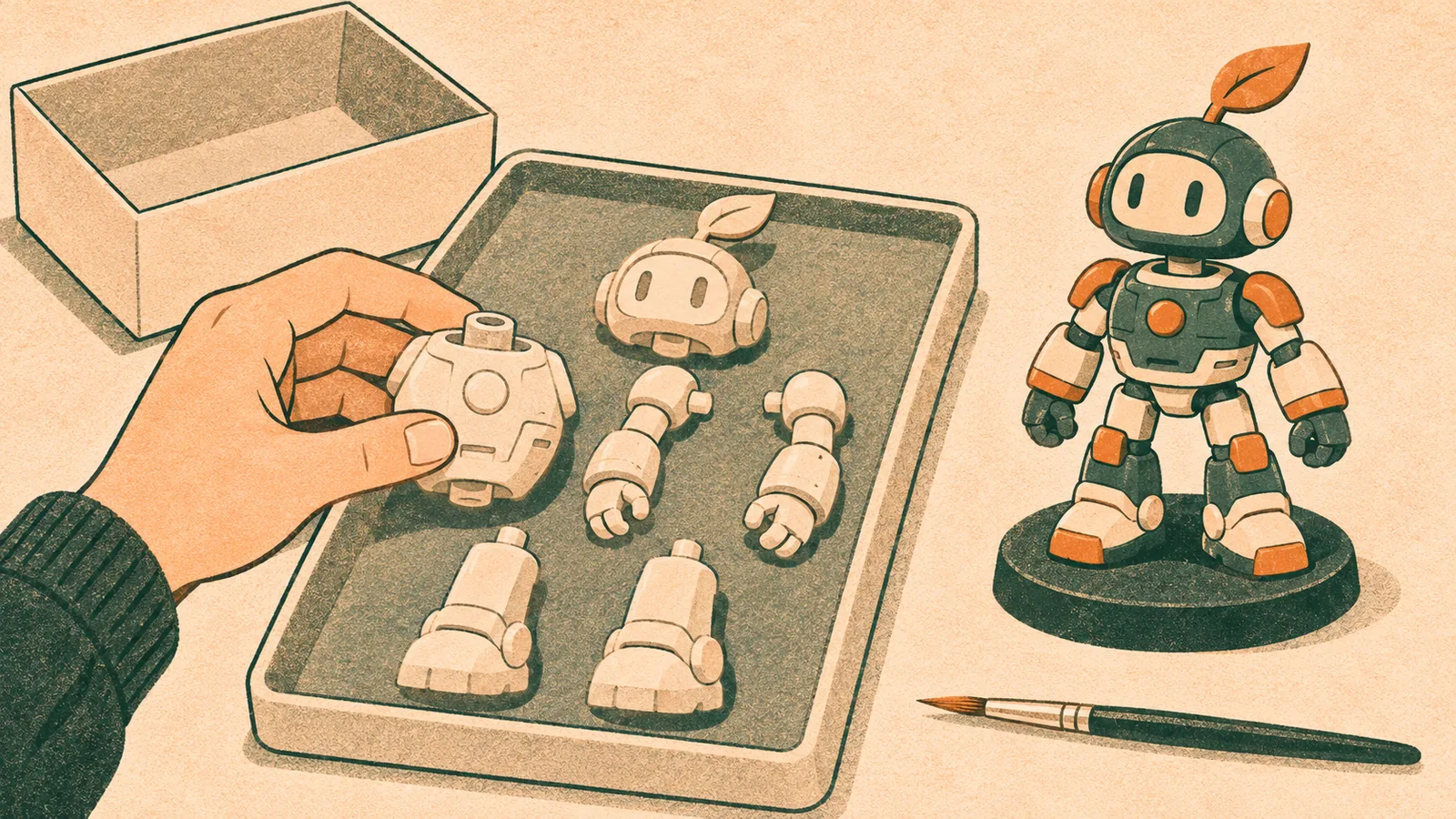
The unfinished state is part of the appeal. The sculptor has decided the pose, proportions and details; the person building the kit can make further choices about colour, surface and presentation. A box of parts therefore offers a different relationship with a figure from placing a finished collectible on a shelf.
Quick answers
Does a listing’s photograph show what comes in the box? Check the listing and instructions. A painted display sample can show a possible finish rather than the condition of the supplied parts. Look for 未塗装 (unpainted), 未組立 (unassembled) and 完成品 (finished item), and confirm what the seller actually includes.
Are all garage kits plain white and difficult to paint? No single description covers every kit. For example, Volks’ CharaGumin range uses colour-separated resin parts designed to produce a colourful figure through assembly. That is the manufacturer’s particular approach, not a promise about all resin kits. CharaGumin
Do I need to sculpt the figure myself? Building a supplied kit is different from creating its master sculpture. Your work begins with the supplied components. What preparation, fitting, assembly and painting they require depends on that kit and the finish you want.
How long does one take? There is no useful universal completion time. The Japanese accounts below describe particular projects, prior experience and compromises. Treat them as perspectives on the work, rather than a timetable for your own first build.
The sculptor supplies a form; the builder gives it a finish
Wonder Festival’s explanation describes taking moulds from an original sculpture and casting parts in resin. That distinction matters: the maker’s sculpture establishes the physical form, while the supplied kit lets someone else assemble and finish a version of it. The organizer’s page illustrates a casting method; it does not mean every contemporary kit uses an identical production process.
For a visitor looking at a display sample, this changes what there is to notice. A silhouette or expression may belong to the sculpt. A particular colour balance, gloss or painted eye can belong to the finish. Both contribute to the object you see, but the kit’s contents may not reproduce all that work automatically.
This also explains why a finished example is not a complete measure of the task. Before choosing a project, look at its parts and instructions as well as the attractive display image. Ask which features are already formed or coloured, which require your work, and whether the photographed base or optional elements are included. These are useful questions for the specific maker, not assumptions about a whole category.
A coloured-resin kit offers another starting point
Volks describes CharaGumin as a resin assembly-figure range with parts divided by colour. It presents the design as a more approachable way to experience completing a character yourself. The example is useful because an unfinished model need not begin as one uniform colour.
It still helps to distinguish supplied colour, assembly and additional finishing. Someone may be content with the assembled appearance; another builder may want to add details. Read the particular kit’s instructions before deciding what is optional or required. A brand’s beginner-oriented description does not establish that every design takes the same effort.
Two Japanese builders describe the distance between an idea and a finished model
These are individual hobbyists’ accounts, not product tests by us or a survey of Japanese model-makers. Their experiences show different ways of thinking about completion.
Aiming for a finish that can actually be reached
フネタロー (Funetaro), writing on October 28, 2024, describes a more involved garage-kit build after previously assembling and partly painting a CharaGumin. Rather than aim immediately for an ideal result, the writer sets a deliberately lower finishing target. The account includes accidentally cutting away parts, repeated colour adjustments and difficulty painting the eyes. After four weeks, the finished work still falls short of the original target, but the writer accepts it and values the attachment created by working on it. Original build reflection
The point is not that four weeks is normal or that mistakes are compulsory. It is that a completion goal can differ from a display sample. Choosing which result would satisfy you gives the project a boundary. A first finish can be something you want to keep without exhausting every possible improvement.
Finishing first, then seeing what could have been different
らきすし (Rakisusi) posts an account on November 7, 2025, of an Engage SR3 model completed in November 2021. The distinction between posting and completion dates matters. The writer recalls concentrating on getting it finished, then wishing more colour detail had gone into the frame. Thin pipe-like parts broke repeatedly, yet finishing the model was a source of satisfaction. The account also offers the personal view that familiarity can make garage kits feel easier. Original retrospective
That is a useful counterpoint to treating difficulty as fixed. Experience changes what someone finds manageable, and finishing can reveal the choices they would make next time. It does not follow that any resin kit will be easier than a plastic model, or that these two builders faced the same task.
Together, the accounts make room for affection and frustration in the same hobby. The result can matter because of the decisions and repairs behind it, as well as the character or design it represents.
Choose a project, then define its scope
Before committing to a kit, separate three decisions:
- The object: do you want this particular sculpt, and have you confirmed the supplied parts, scale and condition?
- The work: which preparation and finishing tasks does its maker specify, and which have you already practised?
- Your stopping point: would an assembled coloured kit, a restrained paint scheme or a more elaborate finish satisfy you?
Keep the project’s practical requirements alongside its visual appeal. Check the instructions, tools, workspace and materials before buying extras. Follow the kit and material manufacturers’ handling instructions; a finished photo cannot tell you whether your workspace suits the work involved. This article is a cultural introduction, not a substitute for a kit’s technical instructions.
You can also enjoy sculpting and finishing without making an immediate purchase. Look carefully at a maker’s authorised photographs or an exhibition display, and ask about the relationship between the parts and the finished sample. Confirm photography permission before recording someone’s work.
Why event permissions are a separate question
Wonder Festival’s current 当日版権 (tōjitsu hanken) handbook describes a system in which the organizer acts as a contact point for rights-holder permission, limited to the event day and venue. It explicitly says applications are not guaranteed approval and that products authorised through this system cannot be sold outside the venue. Official handbook, opening section
This explains one event’s arrangement; the words “garage kit” do not establish a product’s permission status or where its maker may sell it. Follow the actual creator’s and organizer’s information rather than treating an event-specific permission as a general online-sales licence. The handbook is a changing resource, so consult the current version for participation.
If the attraction is discovering the person behind an object, our Design Festa guide approaches original art through maker encounters. Garage kits add another possibility: taking part in the making yourself, after the sculptor’s work has reached you in pieces.
Sources and checked date
Researched November 3, 2026 using the linked Wonder Festival explanation and current handbook, Volks’ CharaGumin description, and the original accounts by Funetaro and Rakisusi. Product specifications, support and event conditions should be checked with their current official sources.
Japanese writing was read and paraphrased with automated translation assistance, with a separate check of dates, qualifications and the distinction between the two builders’ experiences. No independent bilingual review or hands-on kit test was conducted. English garage-kit coverage already exists; our contribution is the comparison and interpretation of these Japanese sources. No source photographs have been reproduced. The main illustration depicts an invented kit.