
Akihabara · Japan
Ita-Bags Explained: Fan Display, Friendship and Comparison
What is an ita-bag, and why repeat the same badge? Explore Japanese fan perspectives, display choices and a practical way to plan your first arrangement.
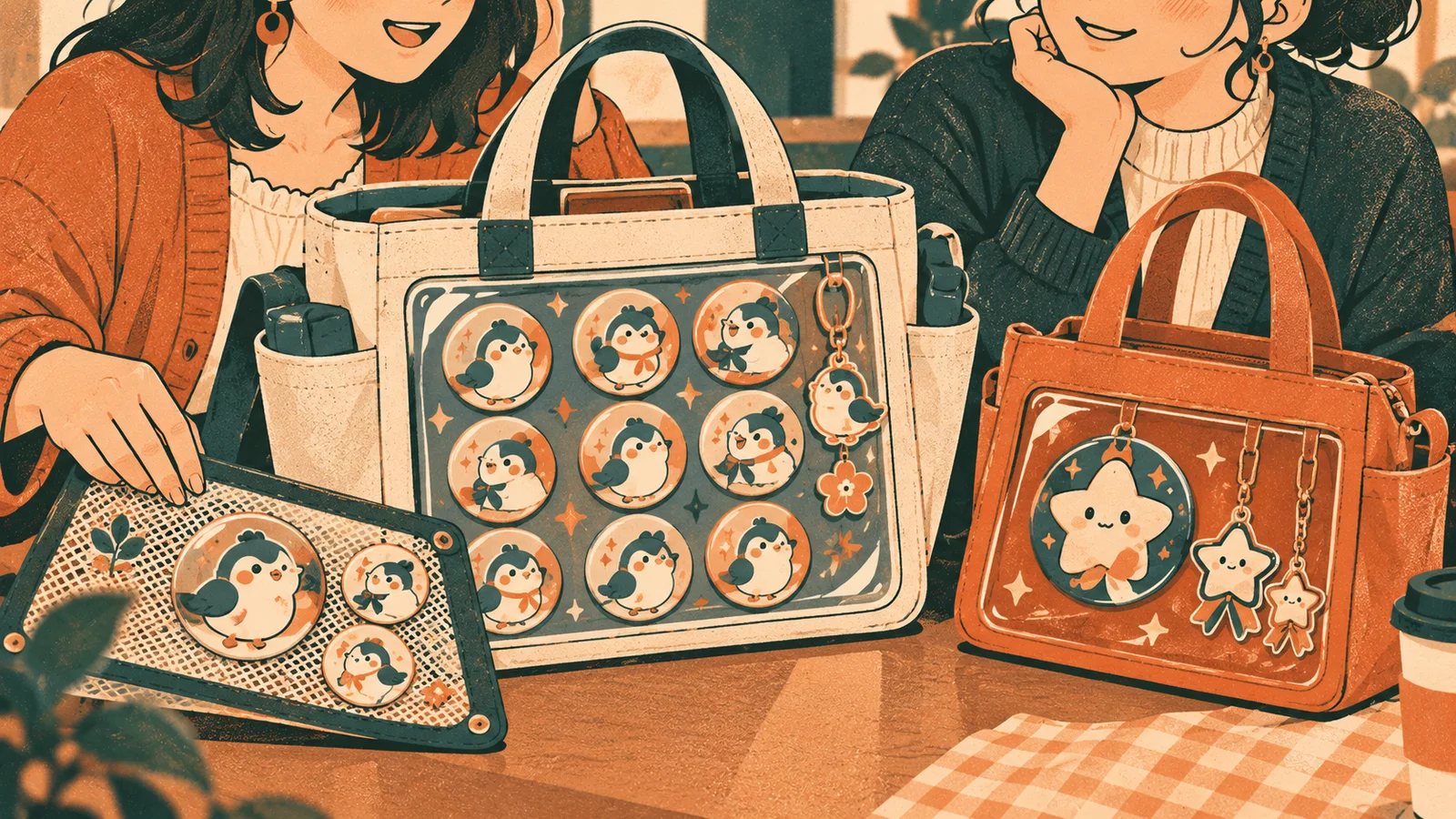
An ita-bag is a bag decorated to display merchandise for a favourite character or performer. Round button badges, charms and other small goods turn the bag into something its owner can arrange, carry and show. A clear display compartment is one familiar form; the practice also includes goods attached to a bag’s exterior. Current clear-pocket example, collector interview
Written 痛バッグ, shortened to 痛バ (ita-ba), the name is often rendered “painful bag.” Japanese introduction The object itself is easier to understand as a small, portable fan exhibition. Its arrangement can say who someone supports, invite a conversation or become part of a photograph with friends. It can also bring questions of visibility, cost and comparison into the same space.
Quick answers
Why are there so many identical badges? Repeating an image makes a strong visual pattern and keeps attention on a particular character or design. Collectors also use mixed images, different expressions and combinations of goods. A repeated grid is one choice, rather than a requirement. Collector’s account
What does oshi mean? Your oshi is the person or character you particularly support. The bag makes that attachment visible. It need not explain everything about your interests to everyone who sees it.
Do I need an expensive collection to start? You can plan a display around goods you already own. Decide how much space you want to fill before treating a photograph of someone else’s finished bag as your shopping list. This is our suggestion for starting, not a rule imposed by the Japanese interviewees.
Must I show it throughout the journey? Visibility is a choice. Some purpose-made bags have a reversible insert or a flap covering the display. Check the actual model’s construction. For example, WEGO describes a reversible mesh-and-fabric insert in its Tokimeki Memory S bag, while its Magical bag uses a removable flap.
How a bag becomes a display
The bag gives the collection a frame. A colour can connect the objects, a row can emphasize repetition, and one larger item can become the centre of an otherwise open arrangement. These are visual choices you can make without reproducing someone else’s layout.
A removable insert makes the arrangement a separate part of the bag. WEGO’s mesh-sheet page offers a useful example of how size affects a display: its table estimates 24 badges of 57 mm or 15 badges of 75 mm for the S insert. The maker explicitly says that arrangement and item thickness can change the number. Those figures concern that insert, not every bag labelled S or A4. Maker’s sizing table
This is why counting badges comes after choosing a layout. A round badge’s diameter, its cover and how closely you place its neighbours all affect the result. If you want space for a charm or ribbon, leave that space in the plan. A capacity estimate tells you something about fit; it does not tell you how much merchandise a satisfying bag needs.
The linked products illustrate different construction choices. We have not bought or tested them, and these examples are not a ranking of bags or a claim about current stock.
Three Japanese voices, with different reasons for carrying one
A collection you can show and exchange
In a February 16, 2018 interview with Denfaminicogamer, the collector セカンド recalls starting around 2011 after accumulating character goods through box purchases. Putting them on a bag gave those objects a use and offered a way to show different expressions of a favourite character. The display also made merchandise exchanges easier because other fans could see the collector’s interest. Original interview
That is an individual account of beginning, not evidence of one inventor or an exact national starting date. Its useful insight is the connection between arranging objects and meeting people: a display can do some of the work of an introduction.
Matching can connect people—or feel too close
A March 19, 2025 interview by 推し活総研 brings together two fans, identified as M and N. N says that encountering a bag with the same badge design can make it easier to start talking. M prefers not to carry the same badge image as someone else, while enjoying other bags as inspiration. Two-fan interview
The difference matters more than a supposed universal etiquette. Similarity can feel like recognition to one owner and a loss of distinctiveness to another. If you like someone’s display, ask about the choices they made rather than assuming they want you to reproduce it exactly.
A display does not mean being visible everywhere
In that interview, both value photographs and friendship. N also describes competition with fans of the same favourite, and hiding the bag until taking photographs. M hides it in their home area. These are personal choices, not travel rules for all fans.
The source is published by CDG and Oshicoco’s research and media initiative. Together, these interviews offer three selective perspectives, not a representative sample or a measure of how common each motive is in Japan.
Affiliation, originality and comparison
These accounts suggest three questions a bag can carry at once: “Who do I support?”, “What did I make?” and “How does my display sit alongside someone else’s?” Those are our reading of the interviews, not a scale on which to score an owner.
The same repeated image can serve different purposes. It may make a favourite immediately recognizable, create a pattern its maker enjoys or coordinate with a friend’s display. Looking only at quantity misses those possibilities. Looking only at the finished photograph also misses the decisions about when to show the bag and when to put it away.
For a first arrangement, it may help to choose a purpose you can actually judge: a colour combination you enjoy, a favourite expression you want to see, or a photograph you want to take with a friend. That gives you a stopping point based on your own project. It does not require winning an imagined comparison with every other fan.
Plan a first arrangement in three passes
- Choose what the display is about. Lay out the goods you already have. Decide whether you want one image repeated, a collection of expressions or a few different objects connected by colour. Photograph the loose layout before attaching it.
- Check how the bag works. Measure the actual display area and insert. Follow the maker’s instructions for attaching goods, and check that the arrangement fits when the pocket closes. If you want to cover it, test that feature with the display in place.
- Try carrying the finished version. Add the ordinary things you will take, then consider the weight, access to your belongings and space the bag occupies. An arrangement that looks good on a table still has to work for your journey.
These are practical planning suggestions, not a tested assembly manual for every bag. At an event, the venue’s bag, photography and storage rules apply. Ask before photographing another person’s display or including them in your image.
If arranging a small companion for photographs appeals to you, our nuikatsu guide explores how fans dress, pose and travel with plush toys. The cheering-screenings guide explains another setting where fans make their support visible and audible.
Sources and checked date
Researched October 31, 2026. Japanese perspectives come from the dated Denfaminicogamer collector interview and 推し活総研’s two-fan interview. Construction examples come from WEGO’s current pages for the reversible-insert bag, flap-cover bag and mesh-sheet sizing table.
We read and paraphrased Japanese material with automated translation assistance. The analysis and planning suggestions are our editorial interpretation; we have not interviewed these participants or tested the linked products. English explanations already exist, including The Oshi Lab’s guide. Our contribution is the comparison of attributed experiences and construction choices, not a claim to introduce an unknown practice. No source photographs or character artwork have been reproduced; the illustration contains invented merchandise.