
Akihabara · Japan
Japanese Miniatures and the Stories Small Scenes Tell
Explore Japanese miniature photography and street dioramas through Tatsuya Tanaka and MAJIRI, and learn to read scale, viewpoint and detail.
A miniature scene gives small objects a setting and a relationship to one another. Japanese photographer Tatsuya Tanaka places tiny figures beside everyday objects so that a familiar shape can become part of a landscape. Urban model maker MAJIRI and Cityscape Studio build streets whose roads, buildings and weathered surfaces invite a closer look at a place. Their approaches give you two ways to read a scene. Look for the clue that establishes its scale, then notice what that clue lets you imagine. Tanaka interview, Cityscape Studio
Quick answers
What is a diorama? Here it means an arranged three-dimensional scene. Buildings, figures and terrain can work together to show a place or an action. A photograph can then choose one viewpoint on that arrangement.
What does mitate mean in miniature photography? In Tanaka’s work, mitate (見立て) means seeing one thing as another. The object stays recognizable while the figure or setting suggests a second use for its shape. The Hokkaido Museum of Modern Art describes this as creative reinterpretation. Museum exhibition record
What does 1:150 scale mean? One centimetre in the model represents 150 centimetres, or 1.5 metres, in the full-size scene. Cityscape Studio names 1:150 as a specialty. Look for a stated scale on each work, since the studio’s Shibuya model for Small Worlds uses 1:80. Studio profile, Shibuya project
Tatsuya Tanaka gives a familiar object a second role
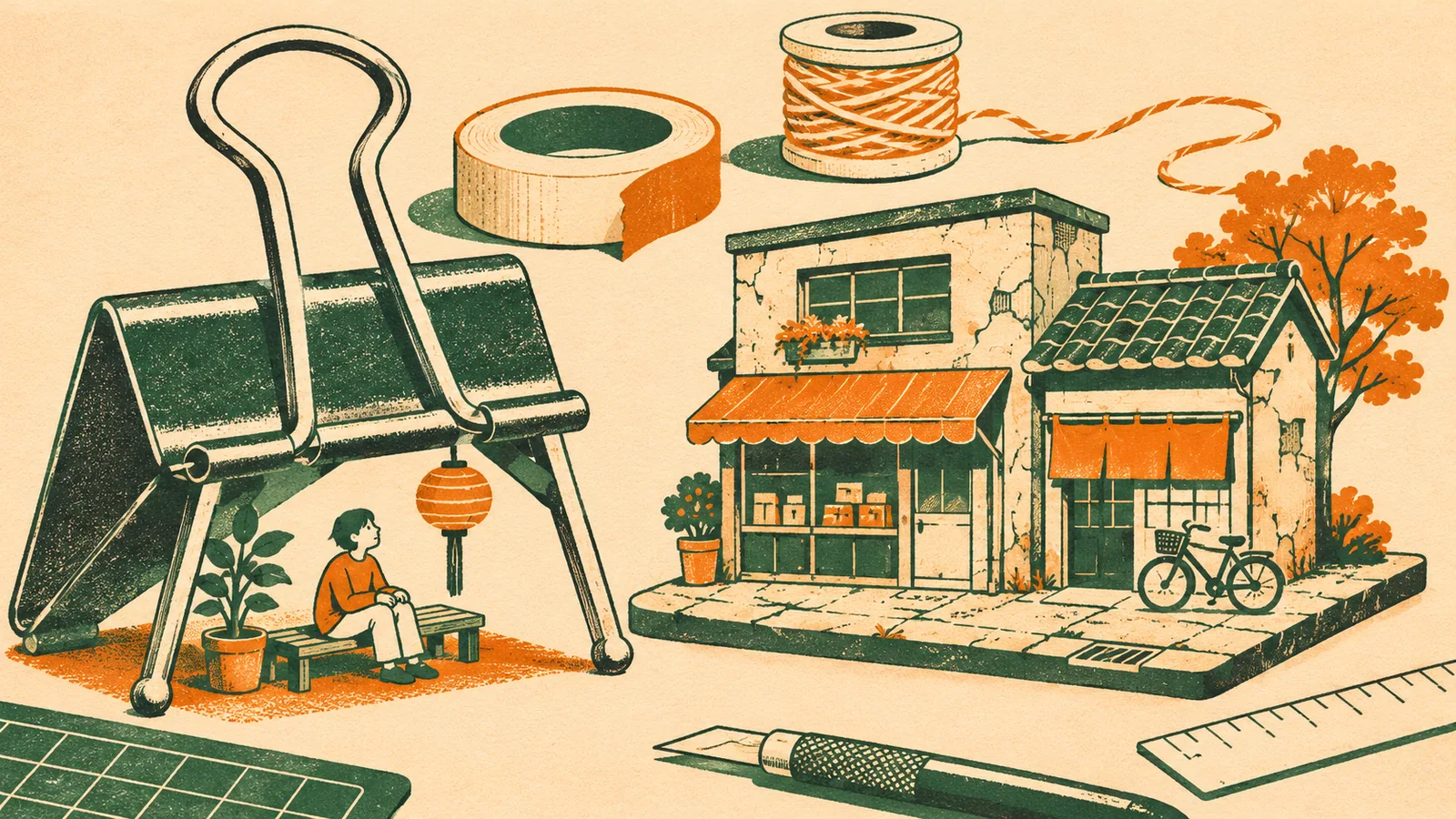
Imagine a binder clip propped open on a table. Set a tiny seated person beneath its folded metal body and the clip starts to read as a shelter. You still need to recognize the clip for the visual joke to work. The figure supplies a second sense of scale, one in which the metal is wide enough to form a roof.
Tanaka describes a similar process in a September 2017 interview with Sony. He keeps everyday objects that might suit a future scene and looks for shapes that a viewer can identify quickly. He mentions broccoli because its familiar size helps the viewer see how small the figures are, while its shape can suggest a tree. He uses figures of different sizes to suit different objects. Sony interview with Tatsuya Tanaka
The photographer also has to decide what the frame reveals. Tanaka describes trying different angles and degrees of background blur. A familiar object needs enough room in the image for its shape to register. The figure needs to be placed so that its pose makes sense in the imagined setting. In his 2018 interview with Nippon.com, Tanaka says he sometimes starts with a material and sometimes with a scene he wants to build. Sony interview, Nippon.com interview
MAJIRI makes an ordinary street worth a second look
Cityscape Studio describes modelling roads, railways and buildings alongside dirt and weathering that suggest how people use a place. Its profile of MAJIRI identifies preserving scenes from the Heisei era, which ran from 1989 to 2019, as part of his purpose. The studio also shares its making process, giving viewers a chance to see how those small details come together. Cityscape Studio profile
A street model can put relationships in view that are hard to see at pavement level. The studio’s account of its Shibuya project describes a scene that includes the crossing, the station and the space below ground. You can follow a route through the scene and notice how the station connects to the streets around it. Then look at the scale of an individual person or shop and imagine the same route from there. Shibuya project
Weathering changes the kind of story a model can suggest. A clean façade shows the shape of a building. Wear around a door or a patched stretch of pavement gives you something to look at when you imagine people using that street over time. That is a way to interpret the details the studio describes.
Three things to look for
- Find the scale clue. Start with a figure, a door or a recognizable object. Ask what it tells you about the size of the other things in the scene.
- Follow the viewpoint. Look at what you can see from above and what a figure would see at street level. In a photograph, notice what the maker leaves in focus.
- Pick one detail that tells a story. A tiny seated figure can turn a clip into a shelter. In a model street, an awning, a bicycle or a worn threshold can suggest how someone uses the space.
For another way to look closely at small objects, see our guide to shape and colour in sofubi.
Sources
The maker accounts are Tanaka’s September 2017 Sony interview and March 2018 Nippon.com interview, and Cityscape Studio’s profile and Shibuya project page. The Hokkaido Museum of Modern Art supplies the exhibition context for mitate. We checked the sources on November 12, 2026 and checked the English paraphrases against the original Japanese accounts. Sony, Nippon.com, Cityscape Studio, Hokkaido Museum of Modern Art