
Akihabara · Japan
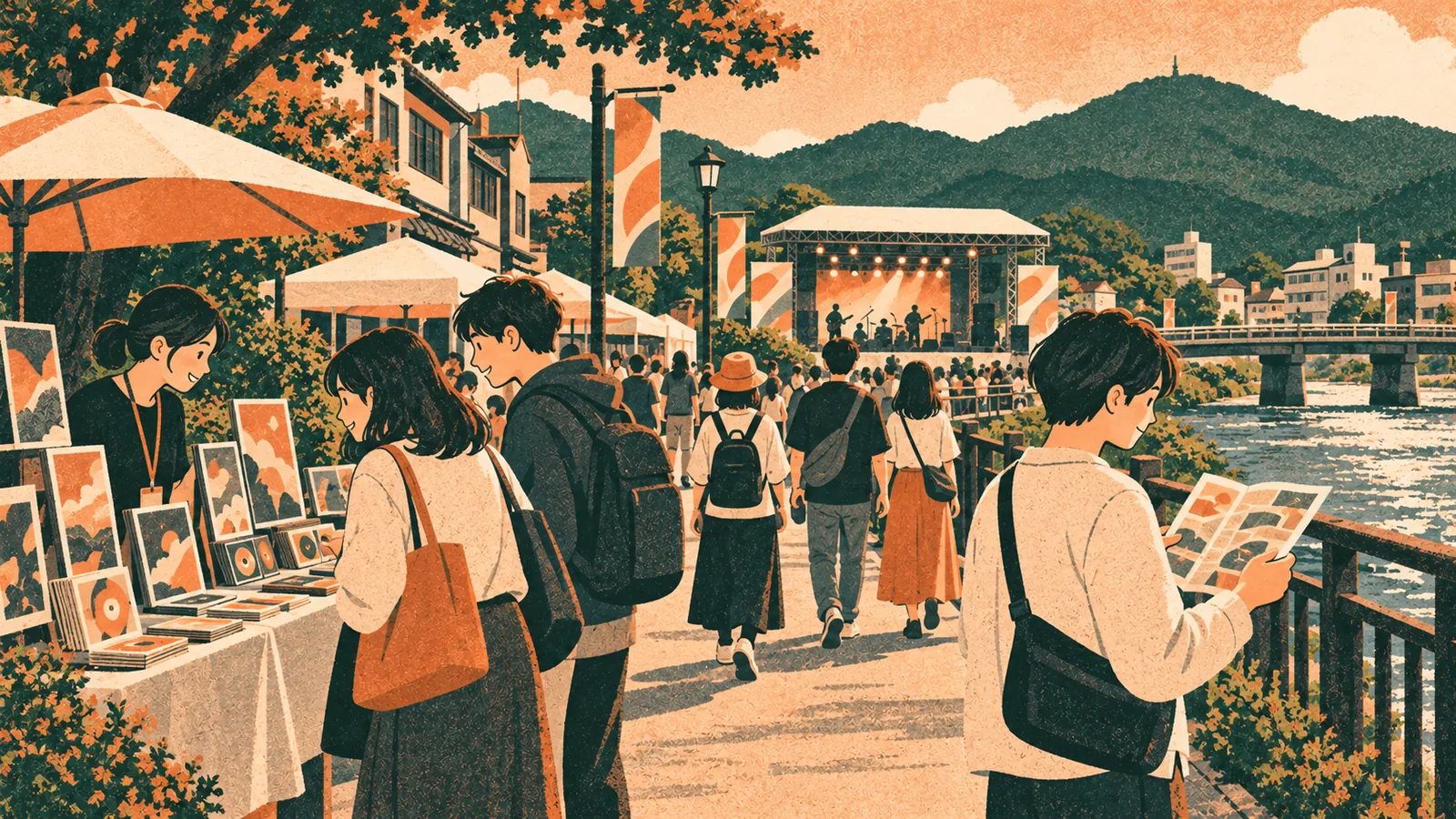
Machi★Asobi 2026: Tokushima’s Town-Wide Anime Festival
Explore Tokushima’s town-wide anime festival through its October 2026 programme and Japanese fan perspectives. Main festival dates have passed.
Machi★Asobi is an anime and game festival spread across Tokushima city, on Japan’s island of Shikoku. Its appeal is the mix: a voice-actor stage, a cinema conversation with creators, a riverside exhibitor stall and time exploring the town between them.
Update, October 19: the main October 17–18, 2026 festival dates have passed. This page retains the edition’s announced programme and cultural background as an archive, rather than current booking guidance. The organizer’s announcement lists vol.31 on those dates, with an eve event on October 16. The separate Bizan Ropeway collaboration is scheduled through November 23; its own conditions apply. All times below are Japan Standard Time.
Quick answers about this edition
Where is it? Tokushima, rather than Tokyo or Akihabara. Activities use multiple locations; follow the official area map and each session’s venue information.
What did the programme announce? Examples included a Demon Slayer cast stage, a Witch on the Holy Night stage and an indie-game creators’ conversation. Their original announcements are retained below; this is not confirmation that every session proceeded exactly as planned.
Was there one ticket for everything? The edition had activity-specific arrangements. Its cinema notice described numbered tickets and a ¥500 facility day pass for the cinema’s free events. Supporter contributions were separate. These expired procedures must not be used to book a later edition.
Was English interpretation available? It was not verified for the selected sessions. Japanese-language programme information and dialogue are distinct from enjoying exhibitor displays or the town setting; check a future edition’s own language provision.
Why the town matters
At a conventional exhibition, the building gives the day its shape. Here, moving between places is part of the experience. The word machi means town; asobi means play. You can follow a particular work or performer, but the setting also makes room for encounters with subjects you did not come looking for.
Tokushima Prefecture’s English introduction to Machi★Asobi describes riverside stalls, cinema talks and collaborations involving local places. It is useful background, but its undated descriptions are not a timetable for the 2026 edition. In particular, do not assume a venue or activity described there operated during this edition, or will return for a future one.
The 2026 programme offers a concrete example of the town becoming part of a work’s presentation. The organizer announces Demon Slayer character guide announcements on the Bizan Ropeway, scheduled from October 17 through November 23. The ropeway takes visitors up Mount Bizan; the collaboration continues beyond the two main festival days. See the specific announcement for the accompanying round-trip-ticket promotion. It is a separate activity, not evidence that ropeway travel is included with a stage visit.
Three announced programme examples — October 17–18 archive
These are historical announcements for dates that have passed, not a live schedule or booking offer.
| Activity | Announced time and venue | Why it may interest you |
|---|---|---|
| Demon Slayer stage | October 18, 10:00–10:45; Aibahama Park | Voice actors Natsuki Hanae, Yoshitsugu Matsuoka and Makoto Furukawa were announced. Aniplex’s October 9 notice also announced ABEMA streaming; replay availability is not verified. |
| Witch on the Holy Night stage | October 18, 15:00–15:40, planned; Aibahama Park stage | Haruka Tomatsu and Yusuke Kobayashi were announced for the film’s stage, part of a sequence involving four TYPE-MOON works. |
| Indie-game creators’ conversation | October 17, from 13:00; ufotable CINEMA, Theatre 2 | Yosuke Shiokawa of 213℉, Masashi Kimura of room6 and HafuHafu Oden of Hakaba Bunko were listed for a conversation about indie games. |
Sources: Aniplex’s October 9 Demon Slayer notice, September 25 Witch on the Holy Night notice, and the organizer’s indie-game session page. These sources document the announced programme; we have not established final delivery, attendance or replay availability.
The range matters as much as the names. A cast appearance connects fans to a familiar story, while the indie conversation offers a route into the people and choices behind making games. For a future edition, deciding which experience matters most can be more useful than trying to fit everything into one day.
What Japanese visitors say
Earlier Japanese-language accounts show both the attraction and the compromises. These are individual perspectives from earlier editions, not a survey or a review of vol.31.
A nearby event can change who gets to participate
In a May 2025 first-concert account, note writer こんとん describes seeing the band Mugendai Mewtype at Machi★Asobi. Travel and accommodation costs had previously helped keep live performances out of reach. Having an event close enough for a casual weekend visit changed that calculation.
The writer was not suddenly comfortable with everything: loud sound and obstructed views were part of the experience, and the two days felt different. Nevertheless, hearing the musicians’ playing in person made the performance more meaningful. The account captures a useful distinction: loving a work online and attending its live event are different experiences, even for someone who usually prefers to listen quietly.
That writer’s free concert in 2025 does not establish the admission rules for any 2026 session.
Choosing less can make the day better
Tokushima-based note writer 雨の皇帝!! offers another perspective in a May 2026 first-timer guide: decide what you want from the day instead of trying to see everything. Their approach gives priority to one essential activity, a couple of hopeful extras and room for discoveries.
They describe the physical work of moving through a town festival: walking, waiting, shopping and stopping for food all compete for time and energy. The useful takeaway is the planning principle, rather than carrying over May’s ticket-distribution or transport details.
Together, these accounts explain why the dispersed format can be appealing without making it effortless. It can bring a performance within reach, while asking you to choose where to spend your attention—and your feet.
How entry worked — historical rules, not current booking advice
The October cinema notice specified same-day numbered tickets, queue formation 15 minutes before distribution and a ¥500 facility day pass for ufotable CINEMA’s free events. A seiriken (整理券) is a numbered admission or queue ticket. The optional supporter scheme and COMI-ESS cosplay/photography registration were separate arrangements. Those October 17–18 procedures have expired; prices and rules cannot be assumed for a later edition.
The organizer also announced venue/time changes for two October 17 VTuber performances on October 16. They were outside our three selected examples. This underlines why an advance programme is not a record of what ultimately happened; we have not verified final delivery of those performances.
For a future visit, look for the new edition’s exact entry, cosplay, photography and queue rules. Build the day around one anchor activity, with time for walking, food and rest. Permission to photograph cosplay does not by itself establish permission to record a stage or cinema event.
What the format offers beyond a favourite series
If you enjoy discovering how anime, games and fan activities occupy everyday places, the format itself may be interesting. The indie-game talk is one example of a route beyond a single franchise. If your interest depends on understanding every spoken exchange, however, verify language support before committing to a particular session.
The Japanese accounts above also suggest that you do not have to imitate the most enthusiastic person nearby to appreciate a performance. For a related form of fan participation inside a cinema, read our guide to Japanese cheering screenings.
Sources and checked date
Originally researched October 12, 2026, with cinema entry rules added October 14. Updated October 19 to mark the main festival dates as past and retire their booking guidance; organizer dates, the October 16 change notice and the separate ropeway period were rechecked. Programme sources include the organizer, Aniplex and COMI-ESS notices linked above. We did not attend this edition. This archive does not establish final attendance, session delivery or replay availability; future editions require fresh announcements.
Japanese perspectives come from the two named note writers, with their earlier-edition dates stated. Interpretations were translated with AI assistance and separately checked against the Japanese passages; they are not an independent bilingual review or evidence of national opinion. The main illustration is original conceptual artwork, rather than event photography.