
Akihabara · Japan
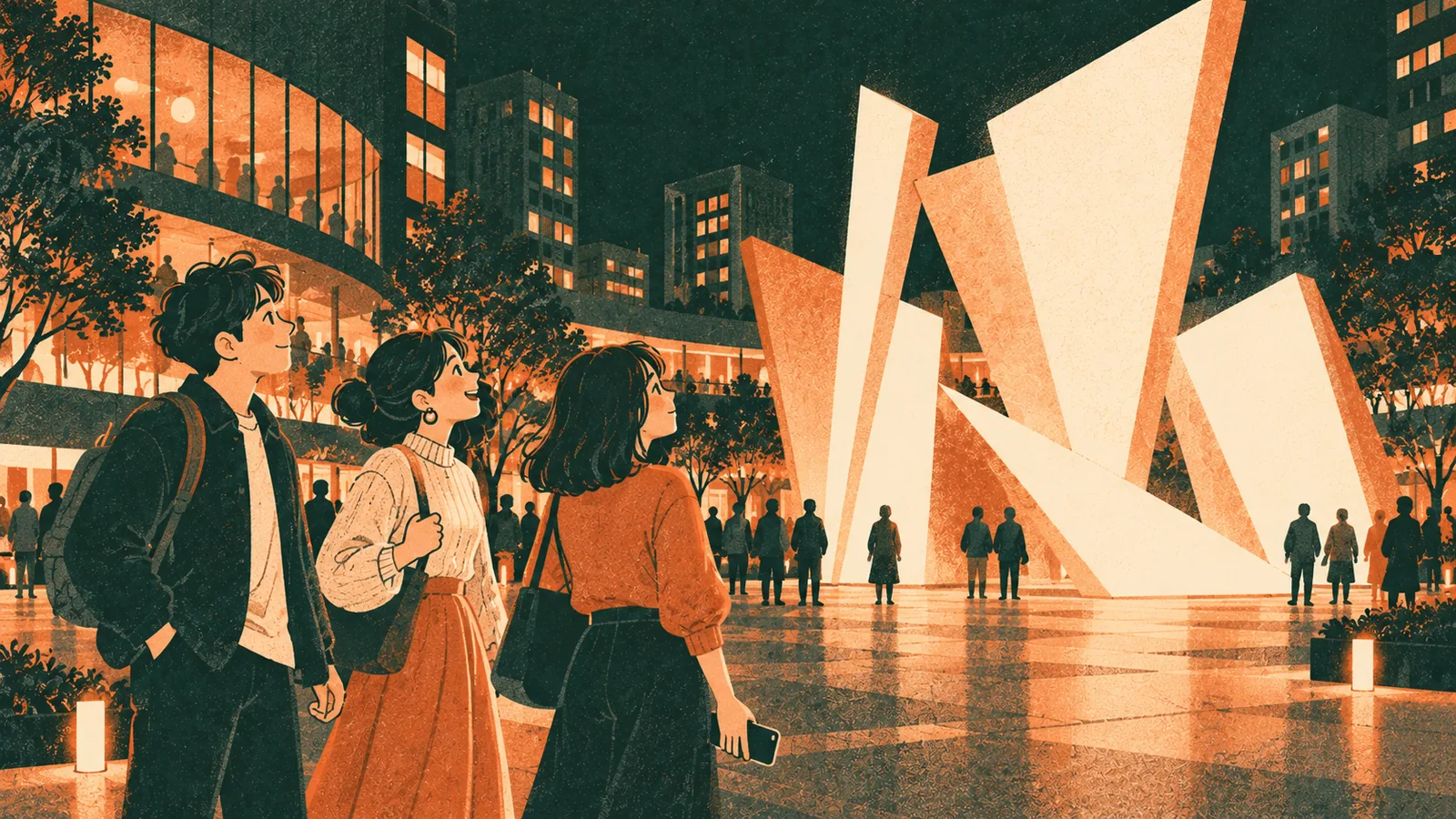
Roppongi Art Night 2026: Choose Your Night of Art
Plan Roppongi Art Night on October 31–November 1: free installations, overnight performances, English tours and Japanese perspectives on looking at art.
Roppongi Art Night 2026 takes place on October 31–November 1 in Tokyo, with its core overnight programme running from 17:00 Saturday to 06:00 Sunday. It spreads contemporary art, design, music, moving images and performance through the Roppongi district. General admission is free, with charges for some programmes and museum exhibitions. Individual works keep their own hours. Official overview
The useful question is how you want to spend the night. You could make a short evening walk around a few installations, arrange an English tour, or stay for a particular late performance. Trying to see everything can leave little time to notice what a work is doing.
Quick answers
Do I need to stay until morning? No. Choose works with hours that suit you. Some installations continue into Sunday evening; others depend on darkness or a scheduled performance. The festival’s overnight span is not the opening time of every venue.
Is there one ticket for everything? General festival admission is free, but museum exhibitions and some programmes have separate charges or reservations. Check the particular work or venue rather than buying a museum ticket as though it were a festival pass.
Can I join in English? The organizer offers three free, reserved English tours. Places are limited; the published application links do not establish that a place remains available. Details are below.
Is this a Halloween cosplay event? Its programme is an art festival. If costumes and character photography are your priority, compare the separate Ikebukuro Halloween guide before choosing how to spend the overlapping weekend.
What makes the city part of the artwork?
Roppongi Art Night began in 2009. The organizers describe the neighbourhood’s museums, commercial complexes and shopping streets as a setting for encounters with art. The 2026 edition focuses on France, home of Nuit Blanche, the overnight festival that provided its model. Organizer’s background
The French programme, RAN Focus, is curated by José-Manuel Gonçalvès, former artistic director of CENTQUATRE-PARIS, and includes installations, film and performance. RAN Focus
For a first visit, think about the difference between seeing an object and entering a situation. You might walk around a sculpture, wait for your eyes to adapt, or watch performers change the movement of a street. Those are different kinds of attention. Pick two or three that interest you, then leave room between them for the city itself.
Three ways to look more closely
1. Let your eyes adjust: Mikiko Kamada’s A Dark Night
At the Piramide Building, this installation uses genetically modified luminous plants. The official description emphasizes adapting to darkness and approaching faint biological light; exhibition cooperation includes LEP and SANKEN at the University of Osaka. It is listed as free, October 31, 17:00–November 1, 06:00. Programme T4, location on the programme map
The interesting viewing prompt here is to give your eyes time. A camera’s bright screen and your own perception need not produce the same experience. The organizer presents the work as a place to discuss technology, researchers’ ethical outlooks and possible futures. That makes it a promising choice for visitors interested in the space between science and art, without needing to treat it as a science demonstration with a predetermined answer.
2. Look past the cute surface: Kim Songhe’s Chandelier
The official profile connects Kim Songhe’s use of discarded plush toys and other toys to growing up in Tokyo as a third-generation Korean resident, and questions of belonging across cultures. It describes a surface that can appear cute while also carrying unease and a sense of being out of place. The work is at Hills Cafe/Space, with an overall exhibition period of October 27, 11:00–November 1, 23:00, and free admission. That range does not establish continuous overnight cafe access. Programme R8
Try looking twice: first at the whole hanging form, then at the familiar things that compose it. What changes when an object associated with comfort becomes part of a larger, less easily classified body? This is a suggested way into the work, rather than an answer you must agree with.
3. Watch a group become a moving body: Tako Mikoshi
野口竜平 × Octopus ∞ Projects presents a street performance with an octopus-like structure carried by eight people. A mikoshi is a portable shrine; here the term is used for an art project exploring individuals and a group. The programme describes collaboration with guest artists and performers recruited in advance, not an invitation for every passer-by to join the carrying. Programme A9
| Scheduled performance, JST | Location |
|---|---|
| October 31, 20:40–21:30 | Seijoki-dori |
| October 31, 23:30–November 1, 00:20 | Seijoki-dori |
| November 1, 01:30–02:00 | 66 Plaza |
All three are listed as free. Watch how the carriers negotiate direction, rhythm and proximity rather than looking only at the object above them. Unlike a stationary installation, the relationship between the work and its surroundings keeps changing.
Choose a visit that fits your energy
An evening visit: select one installation at Roppongi Hills, another street-level work and a performance whose time is already published. Charles Pétillon’s WA, two floating circles made from white balloons at Roppongi Hills Arena, is listed October 31, 17:00–November 1, 22:00, free. It offers a different point of comparison with the faint light of A Dark Night: look at how a large pale form changes the space around it. Programme R1
An overnight visit: anchor the plan around a particular late performance, then check what will remain open nearby. Plan rest, food and your journey back before committing to the night. Festival hours do not establish railway operating hours; check your actual last and first trains and avoid relying on an assumed all-night service.
A museum visit: Mori Art Museum and Tokyo City View announce extended opening on October 31 from 10:00 until 06:00 the next morning, last admission 05:30. For entry from 22:00 to 06:00, their notice directs visitors to the 3F Museum & Observatory ticket counter, with no online tickets for that interval. Under-18s cannot enter between 23:00 and 04:00, even with a guardian. Special event prices remain to be announced in the notice checked for this guide. Nearby galleries, shops and restaurants do not all share the extension. Museum’s English notice
These are planning choices, not a timed route tested on foot. Use the official access information and programme map to connect the works you choose, leaving flexibility for conditions on the night.
English tours
The organizer’s Of Light and Shadow, the Flâneur’s Perspective tours use English conversation to explore art and the city. Flâneur here means an observant urban wanderer. Planning cooperation is by Naoto John Tanaka (田中ジョン直人).
| Tour, JST | Meeting point |
|---|---|
| October 31, 18:00–19:30 | Maman, the giant spider sculpture at Roppongi Hills |
| October 31, 22:00–23:30 | Same |
| November 1, 14:00–15:30 | Same |
Tours are free, with reservations on a first-come basis for about 15 people each, and broadly the same content. Follow the links on the official tour page; remaining places could not be verified. Children under six need a guardian, minors attending alone need parental consent, and the organizer excludes under-18 participation after 23:00. Choose the earlier or daytime option accordingly. In rain, the meeting time/place stay the same and discussion moves indoors.
A Japanese visitor’s reminder: photographing and looking can compete
In an October 6, 2025 account of the previous edition, 水無月憂雨 describes the festival as a reason to finally visit a museum exhibition. The writer also reflects critically on becoming absorbed in taking photographs instead of looking carefully at the work.
The same account records a small disappointment with an interactive bird installation: visiting alone meant activating one bird at a time and being unable to photograph the effect oneself. That is a useful reminder that an artwork’s experience can depend on other people, and that a photo is not always the best measure of a visit. These are one visitor’s reflections on 2025 works, not a prediction of the 2026 programme or a general Japanese opinion. Firsthand account, in Japanese
For your own visit, try giving one work a few minutes before raising your phone. Afterwards, compare what you noticed with a companion. It is a small way to make a crowded itinerary into a more personal encounter.
Before you go
Programme and rules checked October 18, 2026. All times are JST. Some other performance slots still show as undecided. Recheck the official programme and notices immediately before travelling for revised times, weather changes or cancellations. Tour inventory and unannounced museum special prices remain open questions.
If you prefer reading original manga pages in a gallery, the separately ticketed Shojo Manga Infinity exhibition is another option in the area. Its own admission and opening hours apply.
Sources and translation notes
This is an original planning and interpretation guide, informed by the linked Japanese organizer descriptions, individual programme pages and the attributed visitor account. Japanese passages were paraphrased and checked for names, dates, midnight crossings and qualifications. No source photographs or artworks have been reproduced, and we have not attended this edition.
Official English information already exists in the organizer’s introduction, GO TOKYO listing and museum notice. Our contribution is the selection, comparison and practical distinctions, rather than a claim to reveal an event absent from English coverage.