
Akihabara · Japan
Shojo Manga Infinity in Tokyo: Three Artists, Original Pages
Meet Moto Hagio, Ryoko Yamagishi and Waki Yamato through Tokyo’s Shojo Manga Infinity exhibition: original artwork, Japanese perspectives and visitor details.
Shojo Manga Infinity is an exhibition of original drawings and archival material by Moto Hagio, Ryoko Yamagishi and Waki Yamato, opening at the National Art Center, Tokyo on October 28, 2026. It offers a way into three different careers—and into manga as something drawn, arranged and revised before it reaches a reader’s book.
You do not need to arrive knowing every series. Start with a question: how can a page make you feel time passing, a body moving or a person struggling against their circumstances? The three artists offer different routes into those questions.
Quick answers
When and where? October 28, 2026–February 8, 2027, at the National Art Center, Tokyo, Special Exhibition Gallery 2E, in Roppongi. The museum’s exhibition page has the current overview.
What is on display? The museum plans more than 800 monochrome and colour originals, alongside archival material. Colour works rotate between two periods; this is not a promise that every listed drawing will be visible on one visit. Japanese exhibition details
How much does it cost? Advertised adult admission is ¥2,000 in advance / ¥2,200 at the general rate. The advance sales period ends October 27 at 23:59 JST. Student rates and important ticket conditions appear below.
Do I need a timed reservation? The official Japanese ticket page says advance reservation is unnecessary, while noting that visitors may have to wait depending on crowding. Admission still requires the appropriate ticket or free-entry eligibility. Official e-tix information
Will there be English information? The museum has an English exhibition page and English ticket information. We have not verified the languages of every gallery explanation or the audio guide. Check those arrangements if they determine whether the visit will work for you.
Three artists, three entry points
Shōjo is commonly translated as “girls’ manga.” That label alone tells you little about the range of stories here. The official artist profiles introduce careers encompassing fantasy, science fiction, ballet, historical drama and psychological storytelling.
Moto Hagio: lives beyond ordinary time
Hagio’s The Poe Clan follows the vampire Edgar, while works such as They Were Eleven! take readers into science fiction. Her The Heart of Thomas explores the emotional lives of boys. These examples make a useful starting point for someone who associates shōjo only with contemporary romance.
When you look at a page, try following its changes of scale: a face, a figure, a larger image. Where does your eye pause? You can investigate the arrangement even before you understand every line of dialogue.
Ryoko Yamagishi: the body and the historical imagination
Yamagishi’s Arabesque centres ballet, while Hi Izuru Tokoro no Tenshi reimagines the young Prince Shōtoku. Her career also includes myth, fantasy, horror and psychological suspense.
For a first encounter, compare how a body occupies the page. Does a posture direct your eye toward another person, hold a moment still or suggest movement beyond the frame? That is a more rewarding question than trying to absorb an unfamiliar plot from an isolated scene.
Waki Yamato: people within a changing world
Yamato’s Haikara-san ga Tōru is a historical romance set in the Taishō era. Asakiyumemishi adapts The Tale of Genji into manga. The contrast gives you two routes into the relationship between a character and their social world.
Look at how clothing, surroundings and the space between people help tell the scene. Then compare a page with a colour illustration: what changes when an image has to carry a whole impression rather than one moment in a sequence?
These are suggested ways of looking, not claims about a particular installation or reviews of the displayed originals. Check the museum’s work labels for the pieces shown during your visit.
Why originals can reward a slower look
Reading a book encourages you to move onward. In a gallery, you can stop at one page and notice how it works. Try a short sequence of observations:
- Look at the whole page first. Notice the largest shapes and the route your eye takes before reading the dialogue.
- Choose one relationship. Compare two panels, a face and its surroundings, or a figure and the empty space around it.
- Return to the sequence. Ask what changes between images and what the page leaves you to imagine.
The museum’s introduction emphasizes original lines, page composition and colour details. You can use those as prompts without needing to turn every drawing into an art-history test. A small number of attentive encounters may stay with you longer than a rapid attempt to catalogue everything.
The colour-work rotation matters here. The first period runs October 28–December 14, and the second December 16–February 8. Check the museum’s illustrated work list for first- or second-period labels before planning around a particular image.
Japanese perspectives: memory, careers and making the trip
These sources describe the exhibition’s preparation and anticipation. They are not reviews of the unopened show, and they do not represent all Japanese readers.
A curator’s interest in continuing careers
In the museum’s report of a January 22, 2026 Paris discussion, curator Rei Yoshimura explains the choice of these three artists through their historical significance and the question of what a manga artist’s career can be. The report emphasizes sustained creative work and continuing changes in expression, rather than treating the artists only as names from a finished golden age.
The discussion with publisher Bruno Pham also addresses practical constraints around publishing and preserving original manuscripts. That provides useful context for seeing an exhibition as a selection made from material that must be located, cared for and presented. See Clémence Leleu’s Japanese-language report. It is a reported discussion, rather than our own interview or a survey of readers abroad.
An announcement can bring back a reading life
Note writer たから (Takara) describes recognizing the artists’ names in a September 3 reflection. Remembering earlier reading leads to a more personal thought: those manga helped shape how the writer thinks and feels.
That is a different reason to care from knowing the history of the medium. An exhibition can offer a meeting with something already part of your life. The post captures the anticipation of returning to familiar work.
Curiosity does not always become a museum visit
In an October 4 exhibition-planning post, あかね (Akane) says the three-artist show is of some interest but that they probably will not go. They had imagined combining it with another exhibition at the museum, which they had already visited.
This is an itinerary decision, not a negative judgment of the manga or the exhibition. It is a useful reminder to decide what you want from the visit: renewed contact with a favourite, an introduction to an unfamiliar artist or time looking closely at drawing. You do not need all three reasons.
Visiting details and ticket choices
Information checked October 15, 2026; times are JST. The museum and its official ticket seller agree on the following schedule.
| Detail | Announced information |
|---|---|
| Opening hours | 10:00–18:00; Fridays and Saturdays until 20:00 |
| Last admission | 30 minutes before closing |
| Regular closed day | Tuesday, with exceptions below |
| Additional closures | November 4; December 28–January 5 |
| Tuesday openings | November 3 and December 8 |
| Adult ticket | ¥2,000 advance / ¥2,200 general |
| College student | ¥800 advance / ¥1,000 general |
| High-school student | ¥300 advance / ¥500 general |
Use the official e-tix page for current sales and conditions. It displays tickets on sale, but we have not completed a purchase or verified remaining inventory. Bring student identification when using a student ticket. Junior-high-school students and younger enter free with the required identification or proof of age; check the seller’s eligibility details.
A ticket is valid for one admission. If you intend to see both colour-work periods, plan for separate admissions. Choosing an advance ticket does not mean choosing one of the colour periods for you: check your visit date against the work list and the museum’s closed days.
For another way Japanese visual culture connects a work and its audience, our cheering-screenings guide explores what changes when film viewers participate together. Here, the invitation is to slow down and look at how the page itself tells a story.
Sources and checked date
Exhibition and ticket information checked October 15, 2026 against the National Art Center, the official exhibition site and its linked e-tix seller. This is a researched preview, not a report of our attendance. Check official notices again before visiting.
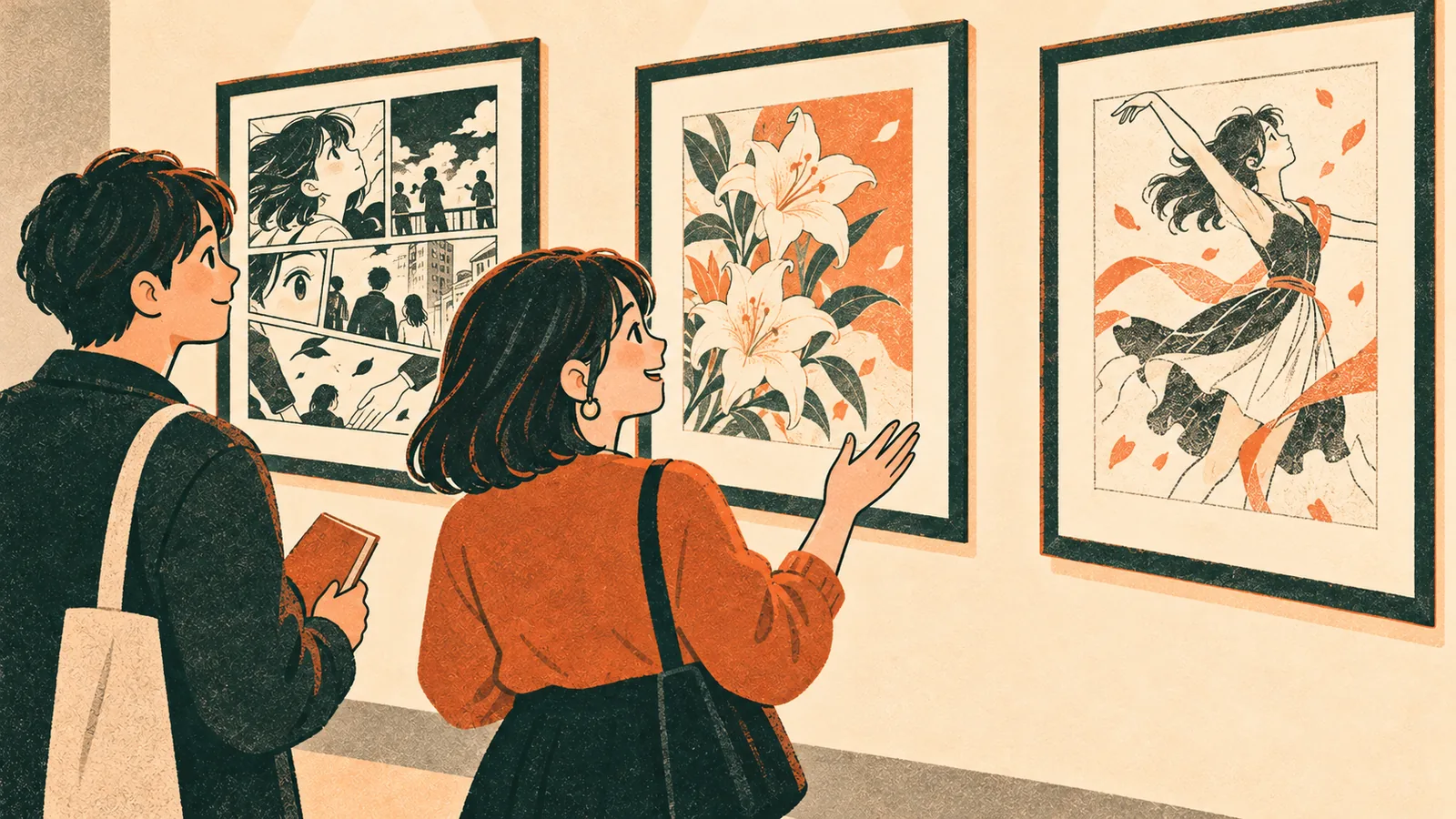
Japanese perspectives are linked and dated above. Translations were made with AI assistance and checked separately against the Japanese wording; no independent bilingual review was commissioned. The curator discussion is credited to its reporter, and the two note posts are personal anticipation and planning accounts. The illustration is original conceptual artwork; no exhibition images have been reproduced.