
Akihabara · Japan
Tsukumo Robot Kingdom: What Happened to Akihabara’s Robot Shop?
Tsukumo Robot Kingdom closed in May 2020. Discover the Akihabara shop’s history, its hands-on appeal and Japanese accounts of making hobby robots work today.
Tsukumo Robot Kingdom’s physical shop in Akihabara closed on May 15, 2020. Its own closure notice gives that date. Older travel guides, photographs and our 2016 archive entry describe a shop you can no longer visit. Official closure notice
The shop is still worth understanding. It brought working robots, kits and advice into a neighbourhood associated with electronics and geek culture. The attraction went beyond seeing a machine move: a visitor could begin to understand how to make that movement happen.
Quick answers
What was Tsukumo Robot Kingdom? A specialist robot shop, known in Japanese as ツクモロボット王国 (Tsukumo Robotto Ōkoku). Tsukumo’s corporate history dates the opening of its robot-specialist store to August 2000. Its range included humanoid robot kits, components, electronic construction kits and books. Company history, 2006 product release
Where was it? In its final period it occupied the second floor of Tsukumo PC Main Store II in Akihabara. Earlier reports describe other floors: a May 2009 reopening report places it on the fourth floor of the main store. These are dated locations, not directions to a current robot showroom. 2020 closure report, 2009 reopening report
Did it move online? A May 2020 Tsukumo announcement, reproduced in the contemporary closure report, said robot sales would move online and the robot webshop was being remodelled. That establishes the plan at the time. We have not verified a currently operating, dedicated Tsukumo Robot Kingdom webshop. For today’s Tsukumo locations, use the company’s current store directory.
Can I still explore Japanese hobby robotics? Yes. Manufacturer catalogues, build diaries and competition reports provide useful starting points. Below, we distinguish an active online catalogue from closed physical shops and look at what two Japanese makers found difficult—and satisfying—about getting a small robot to work.
A robot shop made movement tangible
Tsukumo’s May 26, 2006 announcement for the Kondo KHR-2HV, a two-legged humanoid robot kit, captures the shop’s appeal. It describes servo motors driving the joints and PC software for creating movements. Buyers could choose a construction kit or an assembled version, with different accessory combinations. These are historical products and offers. Tsukumo’s release
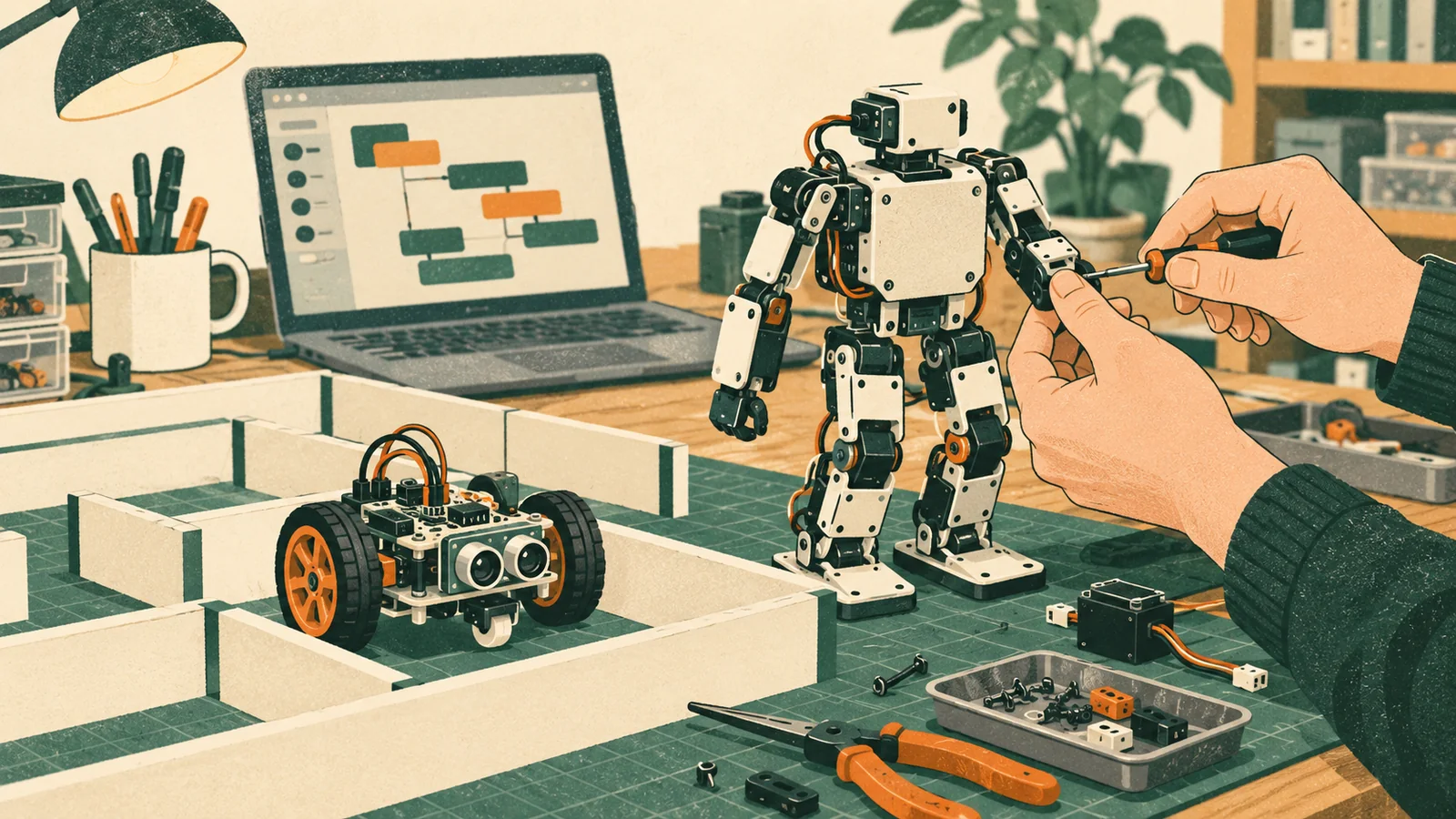
A servo is a motor used to control position—for example, the angle of a robot’s joint. Put several joints together and a wave or a step becomes a sequence of positions. The kit’s software turned that sequence into something its owner could edit. The robot was a moving object and a project at the same time.
The release also states an educational ambition: learning about science and technology through building robots in Akihabara. That helps explain why a robot specialist belonged among electronics and computer shops. It offered a path from looking at a finished machine to working on one yourself.
The physical encounter mattered. In 森山和道’s May 25, 2009 Robot Watch report, manager 廣田実 describes wanting a place where people could see real robots and enjoy them. At the reopening, a Kondo representative assembled and demonstrated a humanoid kit and answered visitors’ questions. Moriyama also observed people dropping in to try controlling a robot. Read the original report
For a newcomer, that could make an unfamiliar hobby less abstract. How does the robot stand? What changes when you alter a movement? Which part of the process would you enjoy? A demonstration gives those questions a visible object.
The shop changed, then closed
By the time 石橋一衛 reported its closure in May 2020, the floor also stocked products connected with Raspberry Pi, Arduino and micro:bit, alongside robotics. His report recalls unusual products that were hard to find in ordinary PC-parts shops and expresses regret at losing a distinctive Tsukumo floor. AKIBA PC Hotline! report
That is one reporter’s assessment, but it points to a useful distinction: the shop could serve someone browsing out of curiosity as well as someone looking for a specific part. The official notice establishes the closure; it does not establish why every customer valued the shop or explain the wider fortunes of Japanese robotics.
It is also easy to confuse surviving web pages with surviving premises. Vstone’s Akihabara Robot Center closed on August 25, 2019, according to Vstone’s own shop overview. The same page explicitly says that workshops are not currently being held, even though older workshop descriptions remain below. Vstone’s shop information
Treat old store photographs as historical evidence. Before planning any specialist-shop visit, find a current official location page and a recent operating notice. A preserved address alone is not enough.
What making a robot feels like in recent Japanese accounts
The underlying activity is easier to follow through a build diary than a list of shops. Micromouse is one example: a small autonomous robot explores a maze, with competitors aiming for a fast route to the goal. RT’s introduction to micromouse explains how it brings together mechanics, electronics and programming.
Two 2026 accounts on RT’s company blog show different stages of that learning. Their authors are employees writing about training and competition, so these are involved personal accounts, rather than independent product reviews or a survey of Japanese hobbyists.
Reaching the goal is only one part of getting it right
In a July 21 account, Ken describes a training robot that could reach the maze’s goal but failed on the return journey. The work shifted to small adjustments: sensor alignment and thresholds, wheel dimensions and the distance between the wheels. Advice from a colleague helped produce a stable return. Ken’s training diary
Ken connects the effort with the satisfaction of getting past a stubborn problem, while acknowledging that asking for help is acceptable. That makes the activity understandable even without following the programming details. A robot moving once is exciting; making it move reliably asks you to look more closely.
A finished kit can become a reason to meet other makers
Writing on October 9, てる (Teru) describes entering a September regional micromouse competition after encouragement from a colleague. Practice exposed return-path trouble despite earlier successful runs. On competition day, the robot completed its exploration and a faster run, but later return difficulties cost time. Teru’s competition account
The account follows casual interest into anxiety, relief and encouragement for other newcomers. It shows another reason a kit can hold someone’s attention after assembly: a different maze and other participants give its owner fresh problems to solve.
These accounts do not establish a direct line from Tsukumo to RT, or show how every maker experiences the hobby. Read beside the older shop interview, they offer a useful connection: seeing a robot work invites curiosity; learning why it sometimes fails can sustain it.
A practical starting point today
If you want to browse actual equipment, Vstone’s current online Robot Shop lists robot kits, servomotors, construction parts and educational materials. Use it as a catalogue of the kinds of components involved. This is an online resource, not a recommendation to visit its closed Akihabara store. Individual stock, delivery destinations and compatibility need checking on the relevant listing. Official online shop
Before choosing equipment, decide what you want to explore: making a humanoid perform a movement, getting a wheeled robot through a maze, or understanding a sensor. Read a build account alongside the manufacturer’s current documentation. Look for the required tools, controller, software, power supply and any parts sold separately.
You can also start without buying anything. Follow the videos and photographs in the linked maker accounts. Watch the return journey, the alignment before a turn, or the adjustment between attempts. Those small details reveal the work behind a short, apparently effortless demonstration.
Tsukumo Robot Kingdom belongs to Akihabara’s history. The pleasure its demonstrations offered remains easy to recognise: a small machine moves, someone asks how, and the next step is to try changing something.
Sources and translation
Researched October 28, 2026. The main historical sources are Tsukumo’s chronology, its 2006 KHR-2HV announcement, its 2020 closure notice, 森山和道’s 2009 firsthand shop report and 石橋一衛’s 2020 closure report.
Present-day context comes from Vstone’s official shop information and online catalogue, RT’s micromouse introduction, and the original Japanese accounts by Ken and てる. Japanese material was read and paraphrased with automated translation assistance. The interpretation is our own synthesis; we did not visit the former shop or interview these writers.