
Akihabara · Japan
2.5D Theatre in Japan and the Character on Stage
What is Japanese 2.5D theatre? Explore manga, anime and game adaptations through actors’ voices and gestures, contrasting Japanese fan accounts and first-visit questions.
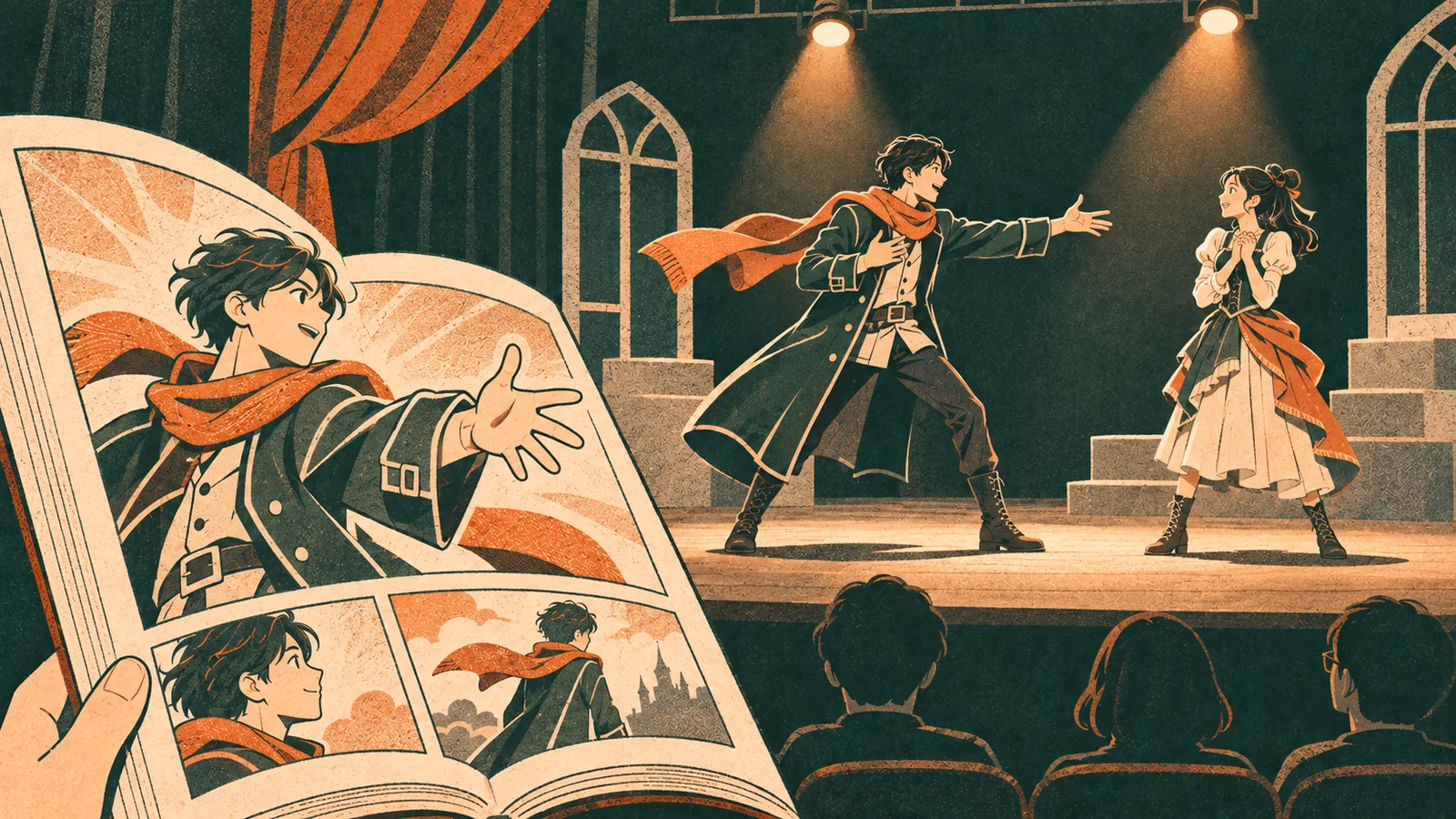
Japanese 2.5D theatre brings characters and worlds from manga, anime and games into live stage performance. The name places it between the drawn, two-dimensional work and the three-dimensional actor. The Japan 2.5-Dimensional Musical Association uses the term broadly enough to include productions without music or singing. Association’s definition
The interesting question is what makes a character recognizable when a person performs them. A costume offers one answer. A pause, a way of turning toward another person or the rhythm of a sentence can offer others. Japanese fan accounts show how those details can create delight, uncertainty or a new interpretation of someone the viewer already knows.
Quick answers
Are all 2.5D shows musicals? No. The association’s umbrella includes spoken stage productions too. Check the actual production’s description for its format, story and performance structure; the label alone does not tell you how much singing to expect.
Is the story an exact adaptation? It can adapt a particular story or create a new one using an existing world and characters. For example, the official Sailor Moon — Shining Theater Shinagawa Tokyo site describes a completely original story. Official introduction
Do I need to know the original? Familiarity gives you more to recognize, but the amount of background needed varies. Read the official synopsis and check whether the show is a continuation of an earlier stage production. A familiar franchise name does not establish that every instalment starts at the beginning.
Can I watch without Japanese? Check support for the specific production and part of the show. As of November 6, 2026, the Shinagawa Sailor Moon production advertises English subtitles for the main show. That wording does not establish translated greetings or support at other productions. Official English site
Recognizing a character through a different voice
An actor brings a body, a voice and a sequence of decisions to a role. For someone attached to an animated or game character, that can make the encounter unusually personal: the viewer already has an idea of how that person should sound and behave.
Consider the difference between appearance and relationship. A performer might look right in a still photograph, while a scene raises another question: how does the character speak to a friend, a student or an enemy? A change in timing or tone can affect that relationship even when the costume stays the same.
The idea of complete faithfulness also has limits as a definition. In the published abstract of her 2026 theatre paper, researcher Mayuko Fujiwara (藤原麻優子) argues that fidelity alone cannot adequately define 2.5D theatre. Her discussion points to manga and anime conventions that make an unusual appearance or manner of speaking intelligible within a fictional world. Paper and abstract
For a viewer, a useful question follows: what does this performance ask you to accept as natural? Once you accept that convention, a stylized costume, movement or delivery can become part of the character’s world. Someone else may find the same choice distracting. The fan accounts below show different versions of that encounter.
Three Japanese accounts of recognition and doubt
These writers discuss different productions and years. Their experiences offer points of comparison, rather than a ranking of shows or a survey of Japanese audiences.
A game character gains small movements
Writing on February 23, 2026, 一般ギョウ界民 describes a first 2.5D experience at the 2025 Neptunia Re:BOOT!! musical. The writer had worried about performers sounding different from the game’s voice cast. In the account, intonation and movement made that difference feel acceptable; small gestures even deepened the writer’s interpretation of the characters. Original account
The writer also enjoyed seeing characters move around continuously, beyond the comparatively static dialogue scenes familiar from the games. This is an enthusiastic recollection written months after the performance, with the writer’s own warning about imperfect memory.
The official production site helps explain one staging choice: its original story makes disappearing music and musical attacks part of the conflict. Singing has a role within that fictional situation. The site documents the October 1–5, 2025 production, not a current ticket offer.
Looking right and speaking differently
The writer of ましろく, reflecting on a first visit to the Jujutsu Kaisen stage production on August 15, 2022, describes both pleasure and unease. They worried that some wording made Gojo seem more violent than their understanding of the character. Over time, noticing how the actor responded differently to students, peers and opponents helped the writer accept the performance. Original reflection
This is the writer’s interpretation, not an objective verdict on the adaptation. It makes a useful distinction, though: recognizing a face and recognizing a relationship are different kinds of recognition. A viewer can enjoy the show while remaining unconvinced by a particular choice.
One difficult encounter need not define the whole form
An anonymous Hatena writer, in a September 15, 2024 essay, recalls initially treating a familiar voice as part of a character’s identity, making stage versions uncomfortable. The essay later describes a different streamed production whose familiar story and conversation-focused performance softened that aversion. The writer also acknowledges changes in their own tastes and expectations. Original essay
Its change of direction matters. The account is neither a blanket rejection nor a promise that everyone will eventually enjoy 2.5D. Different works can offer different ways into the form, and liking a source does not oblige someone to like every adaptation.
Choosing a first production
Start with what you want from the encounter. You might want to recognize a favourite character, see how a story changes on stage or discover a performer. Those interests can overlap, but they need not lead to the same choice.
Before committing to a visit, check a few concrete details:
| Question | What to look for on the official production site |
|---|---|
| Where does the story begin? | The synopsis, named story arc and any earlier stage instalments |
| What kind of performance is it? | Spoken play, musical, separate live section, running time and intervals |
| What language support is offered? | The exact scope of subtitles or other support, including which parts are covered |
| How will you enter? | Your specific date, cast or team, ticket seller and collection or entry instructions |
| How should the audience participate? | Rules for photography, recording, cheering, penlights and separate parts of the show |
The association’s current lineup can help you find productions, but its FAQ makes clear that the association does not organize those shows or sell their tickets. Follow through to the named production and its authorized seller. This guide does not establish remaining seats or prices.
Participation rules deserve their own check. The archived Neptunia rules, for example, limited penlights to the live section after the main story. The current Shinagawa Sailor Moon FAQ permits mobile photography only during specified times and parts. Neither example supplies rules for a different show.
Our cheering-screenings guide explores another setting where fans participate around a familiar work. In a theatre, start with the production’s instructions, then give the actors and the people around you room to experience the performance.
Sources and checked date
Definitions, official production examples and language-support wording checked November 6, 2026. The association, research abstract, production pages and firsthand Japanese accounts are linked beside the claims they support. Fujiwara’s argument is summarized from the published abstract; the fan accounts are individual recollections, not evidence of national opinion or representative audience preferences.
Translations and summaries were prepared with AI assistance and checked separately against the Japanese wording. The illustration is original conceptual artwork with invented characters and staging. We have not attended or interviewed the writers for this guide. Consult current production notices before buying a ticket or travelling.